

Can Jungian psychology move beyond the gender binary without losing its understanding of the unconscious?
For much of its history, analytical psychology has understood the relationship between consciousness and the unconscious through an encounter with an inner figure: the anima in men and the animus in women. These figures were thought to embody qualities belonging to the opposite sex, opening a passage towards parts of the psyche that conscious identity could not easily accommodate.
Yet something remains unresolved in this formulation.
If the unconscious is collective, archetypal, and capable of producing images that transcend personal experience, why should its organisation depend upon two fixed categories of gender?
And if psychotherapy concerns the emergence of a more authentic relationship with oneself, what happens when our theoretical models impose an identity upon the very person we are trying to understand?
Contemporary Jungian psychology is increasingly confronting these questions. For transgender, non-binary, and genderqueer people, the traditional anima and animus distinction can be particularly problematic. But its limitations extend beyond gender-diverse experiences: they concern the fundamental relationship between identity, difference, and the unconscious.
At The Metis Institute, these questions belong at the centre of our developing Depth TA approach, which brings Transactional Analysis into dialogue with analytical psychology, symbolic thinking, and embodied experience.
The task is not necessarily to abandon Jung. It is to allow his psychology to develop beyond some of the assumptions that shaped it.
What Are Anima and Animus in Jungian Psychology?
Carl Gustav Jung understood the psyche as extending far beyond the conscious ego. Beneath personal memories and experiences, he proposed the existence of a collective unconscious: an underlying dimension of psychic life expressed through archetypal patterns, images, myths, and symbols.
Within this framework, anima and animus describe an important relationship between consciousness and unconscious experience.
In Jung’s classical formulation:
- The anima represents the unconscious feminine dimension of a man’s psyche, frequently associated with feeling, relatedness, imagination, and eros.
- The animus represents the unconscious masculine dimension of a woman’s psyche, frequently associated with thought, judgement, assertion, and logos.
These figures were understood as mediators between consciousness and the collective unconscious (Jung, 1968).
A person might encounter them through dreams, fantasies, projections, or relationships with others. They could appear as guides towards psychological development, but also as disruptive forces when their influence remained unconscious.
Their function was therefore significant.
The anima and animus were not simply personality characteristics. They represented something that consciousness could not fully recognise within itself.
However, the traditional model also assigned particular psychological capacities to masculinity and femininity.
Reason became masculine. Feeling became feminine. Assertion belonged to one side, relatedness to the other.
The difficulty is not merely that these associations are outdated. It is that culturally conditioned expectations about gender risk being mistaken for universal structures of psychic life.
Anima and Animus: The Problem With Binary Gender Theory
Jung’s psychology emerged within a particular European cultural and intellectual environment. Social expectations, philosophical traditions, and assumptions about gender shaped his theories during his lifetime.
This historical context does not invalidate his discoveries, but it requires us to distinguish between an archetypal function and the cultural images through which Jung interpreted it.
Susan McKenzie (2006), in her influential article Queering Gender: Anima/Animus and the Paradigm of Emergence, challenges precisely this aspect of classical analytical psychology.
She identifies a fundamental difficulty in assigning archetypal structures according to sexual anatomy, describing the resulting division as:
“[…]a breach in the universality of the collective unconscious.”
— McKenzie (2006, p. 407)
The criticism reaches beyond the question of representation.
If archetypes are universal psychological predispositions, why should individuals inherit different archetypal capacities depending upon their assigned sex?
Why should a woman’s relationship with logic be understood through an inner masculine figure? Why should a man’s relationship with feeling require an unconscious feminine intermediary?
And where would we locate the anima or animus of someone who is non-binary, genderfluid, or transgender?
The classical system offers no satisfactory answer without first assuming the person’s gender.
McKenzie (2006) proposes that gender is better understood as an emergent dimension of psychological development, arising through complex relationships between embodiment, experience, and culture.
This shifts our attention away from predetermined gendered structures and towards the actual development of psychic life.
Perhaps the fundamental question is not whether the inner figure is masculine or feminine, but why consciousness experiences something within itself as Other.
The Inner Other: Beyond Masculine and Feminine
One of Jung’s most enduring contributions is his recognition that the ego is not the totality of the psyche.
We are never entirely who we believe ourselves to be.
Something remains beyond conscious identification: capacities we have neglected, emotions we have rejected, possibilities we have never imagined, and dimensions of experience that do not fit the story we tell about ourselves.
Traditionally, anima and animus gave symbolic form to this encounter with the unknown.
They represented an Inner Other.
From this perspective, their gender becomes secondary to their psychological function.

The Inner Other can represent the unfamiliar, the unrecognised, or the not-yet-developed. It may appear in a dream as a woman, a man, an androgynous figure, an animal, or a presence that refuses classification.
Its symbolic appearance does not necessarily reveal the dreamer’s gender identity, sexuality, or some hidden masculine or feminine essence.
Instead, it may offer an image of a relationship that consciousness has not yet established with itself.
This distinction is especially important in psychotherapy.
A therapist who assumes that a feminine dream figure must represent a man’s anima risks interpreting the dream before listening to the dreamer. Dreams provide one of the most direct opportunities to encounter these figures, as explored in our article on dream analysis in psychotherapy training.
A therapist who remains curious about the figure’s meaning can discover something entirely different.
The first approach imposes theory upon experience.
The second allows experience to challenge theory.
And perhaps this is where analytical psychology becomes most faithful to its own foundations.
The Syzygy: Can Psychological Opposites Exist Beyond Gender?
Jung also understood anima and animus through the concept of the syzygy, a symbolic conjunction of opposites.
In classical analytical psychology, this was often represented through masculine and feminine principles.
Yet the psychological importance of the syzygy may lie less in gender than in its representation of relationship, difference, and the possibility of integration.
The psyche contains tensions that cannot simply be resolved through conscious intention.
Autonomy and dependence. Activity and receptivity. Differentiation and belonging. Destruction and creation.
These polarities may find expression through gendered imagery, but they do not necessarily belong to particular genders.
Indeed, treating them as masculine or feminine can obscure their psychological significance.
Contemporary Jungian researchers have begun exploring alternative formulations.
Saiz and colleagues (2023), examining 141 dreams from nine heterosexual participants in Jungian psychotherapy, investigated anima, animus, and androgynous imagery. Their findings supported further reconsideration of the classical model, particularly the place of androgynous representations.
The study was exploratory, with a small sample that did not include queer participants. Nevertheless, it illustrates the continuing theoretical development of this field.
More recently, James Perrin (2024) proposed the animum, an alternative archetypal formulation intended to move beyond the traditional anima–animus division.
Rather than treating sex, gender, and sexuality as fixed psychological categories, Perrin conceptualises them as dimensions of a shifting psychic landscape.
This is a particularly significant development.
It suggests that individuation does not require reconciliation with a predetermined opposite gender.
Instead, it may involve developing a relationship with the multiplicity, contradiction, and complexity of one’s own existence.
Jungian Psychology, Transgender Identity, and Individuation
There is a danger in attempting to make classical Jungian theory inclusive simply by finding new places for LGBTQ+ identities within its existing structures.
A transgender person does not need to be interpreted as an expression of anima or animus.
A non-binary identity is not necessarily a symbolic manifestation of psychological androgyny.
And genderqueer experiences should not be treated as evidence that someone has transcended the opposites.
These interpretations can appear affirming while remaining fundamentally reductive.
They risk transforming a person’s lived identity into material for the therapist’s theoretical imagination.
Contemporary Jungian scholarship offers more promising possibilities.
Naomi Azriel (2024), writing about the non-binary soul, explores how gender-diverse experiences can challenge the rigidity of inherited psychological categories and contribute to a broader rethinking of individuation.
Similarly, Douglas Thomas (2024) examines the relationship between Jungian psychology and queer theory, including the clinical consequences when adherence to established Jungian concepts prevents a therapist from understanding a transgender patient.
Both contributions invite analytical psychology to question not only its theories, but also the authority with which those theories are applied.
The unconscious should not become an instrument through which the therapist corrects someone’s identity.
Rather, psychotherapy must remain capable of encountering the person before it encounters the theory.
For trans, non-binary, and genderqueer clients, this means that their identities are not automatically treated as symptoms, defences, or manifestations of unresolved archetypal conflict.
Their experiences deserve the same curiosity, complexity, and psychological seriousness afforded to anyone else.
The unconscious remains worthy of exploration. But that exploration must not begin by declaring who the person is supposed to be.
Persona, the Inner Other, and the Problem of Identity
Jung’s distinction between the Persona and anima/animus offers another useful starting point.
The Persona represents the psychological organisation through which we relate to the external world.
It allows us to participate in society, adopt roles, communicate expectations, and maintain a recognisable identity. It is the manifest part of our Script.
Anima and animus, by contrast, were understood as mediators of our relationship with inner experience.
One faces outward. The other faces inward. Yet the relationship between them is rarely harmonious.
The Persona may become increasingly identified with social expectations. Parts of the psyche that cannot be accommodated within this identity may be neglected, concealed, or rejected.
This is not necessarily a problem of gender identity. It is a broader problem of psychological adaptation.
A person may build an outward identity around strength while remaining estranged from vulnerability. Another may identify with kindness while struggling to acknowledge aggression.
In these examples, the Inner Other represents something that the conscious personality has difficulty recognising.
From a Depth TA perspective, the therapeutic question becomes:
What has the person needed to exclude in order to become recognisable to themselves and others?
This question also requires sensitivity to cultural power.
For some people, social adaptation brings belonging. For others, conformity requires the concealment of important aspects of their identity.
Psychotherapy must be able to distinguish between an unconscious defence and a conscious decision to protect oneself within an unsafe environment.
Without that distinction, an apparently sophisticated psychological interpretation can become another form of social pressure.
Relational Constellations: How the Inner Other Takes Shape
The Inner Other is not formed independently of relationship.
Our earliest experiences with caregivers, families, and communities influence how psychological possibilities become available to consciousness.
A child learns not only how to relate to others, but also which aspects of themselves can safely be expressed.
Some feelings are welcomed. Others are discouraged. Certain behaviours receive recognition, while others threaten belonging.
Through these experiences, relationships become internalised and contribute to the organisation of psychic life.
From a Jungian perspective, archetypal predispositions interact with personal experience, gradually forming complexes and relational expectations.
The Inner Other may therefore contain dimensions of the psyche that have become difficult to acknowledge within the individual’s familiar identity.
Importantly, this process cannot be reduced to a child’s relationship with a mother and father understood as two complementary gendered forces.
Caregiving structures, cultural contexts, and family relationships are far more diverse.
The relevant psychological question concerns the quality of those relationships and how they shape the person’s capacity for expression, identification, and difference.
This allows us to preserve Jung’s interest in archetypal and relational development without assuming that psychological wholeness requires a particular family structure or gender configuration.
Depth TA: Bringing the Inner Other Into Transactional Analysis
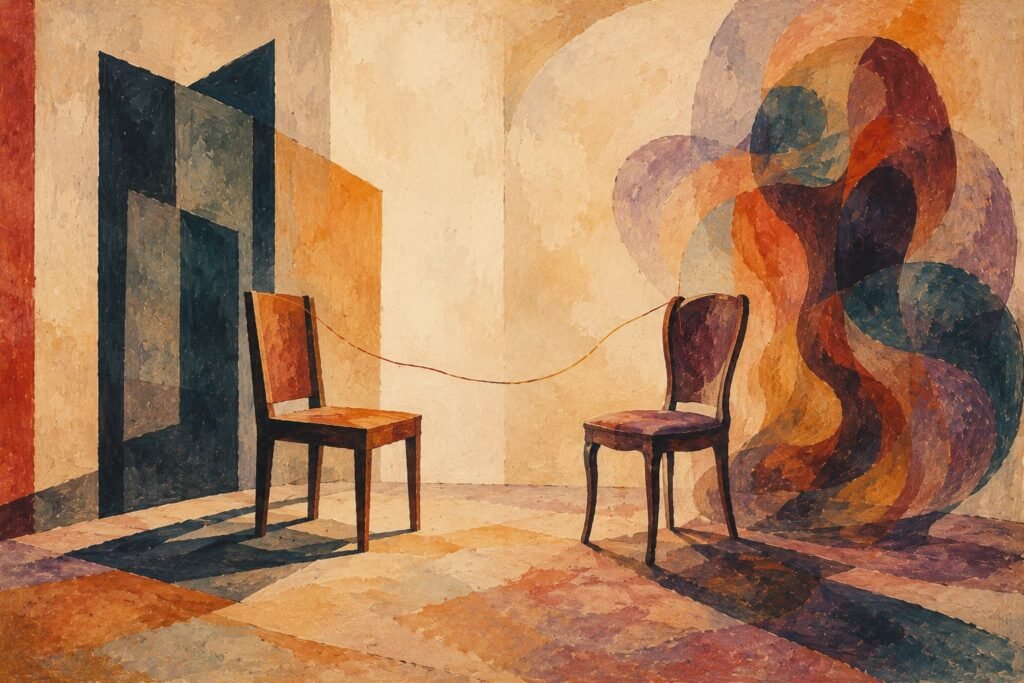
At The Metis Institute, we are developing Depth TA, an integration of Transactional Analysis with Jungian and depth psychological perspectives.
Our aim is not simply to place two theories beside one another.
We are interested in developing a coherent psychological framework in which TA’s clarity can be enriched by the symbolic, archetypal, and imaginal dimensions of the psyche.
Within Transactional Analysis, ego states, script, and relational patterns provide ways of understanding psychological organisation.
Depth psychology extends this enquiry towards the unconscious processes that shape consciousness, motivate behaviour, and influence our relationships.
The Inner Other becomes particularly important because it challenges the assumption that conscious identity tells us everything about the person.
Yet we do not believe that this requires assigning masculine and feminine psychological essences.
Instead, we are interested in how the psyche encounters difference within itself.
This encounter may involve dreams, symbolic images, bodily experience, transference, fantasy, or the emergence of previously unrecognised feelings.
The therapist’s responsibility is to remain curious about these manifestations without forcing them into established categories.
Our developing approach therefore places the tension between the ego and the unconscious at the centre of psychological exploration.
And it recognises that this tension belongs to every human being, regardless of gender identity, sexuality, or embodiment.
Inclusive Jungian Psychology and Psychotherapy Training
Psychotherapy training should not demand loyalty to a theory at the expense of the person.
Students need to understand the classical foundations of their discipline. They also need the freedom to question those foundations.
This is particularly important when studying gender, sexuality, identity, and the unconscious.
At The Metis Institute, we believe that rigorous training requires students to engage critically with the ideas they inherit. Our developing Depth TA approach to psychotherapy explores how the clarity of Transactional Analysis can be enriched by the symbolic and imaginal dimensions of Jungian psychology.
Jung’s theories of anima, animus, and the syzygy remain valuable subjects of study.
But they are not beyond revision.
For prospective students who identify as transgender, non-binary, genderqueer, or otherwise gender-diverse, our approach is grounded in a simple commitment: your identity is not an obstacle to understanding the psyche, nor something that must be explained away by theory.
Your experience belongs within the psychological enquiry.
And for every student, regardless of identity, there is an invitation to think beyond familiar categories and tolerate the uncertainty that genuine exploration requires.
We are interested in forming psychotherapists who can understand theory deeply enough to question it, and who can remain present when another person’s experience exceeds the limits of what they already know.
Beyond the Inner Opposite
Perhaps the enduring value of anima and animus lies not in the genders Jung assigned them, but in the relationship they represent.
There is always something within us that remains unfamiliar.
Something that challenges the identity we have carefully constructed.
Something that cannot yet be reconciled with what we believe ourselves to be.
The Inner Other is not necessarily our opposite.
It may be the part of the psyche that has not yet found a language through which to address consciousness.
If individuation involves becoming more fully oneself, psychotherapy cannot begin by deciding what that self must look like.
It must begin with curiosity.
The psyche does not need to conform to our theories. Our theories need to remain capable of encountering the psyche.
Explore Depth TA at The Metis Institute
If you are looking for psychotherapy training that integrates Transactional Analysis, Jungian psychology, unconscious processes, and contemporary perspectives on gender and identity, we invite you to explore our developing Depth TA approach.
Our training brings together theoretical rigour, relational enquiry, symbolic understanding, and embodied experience.
Book an Open Day to meet our team, explore our philosophy, and discover whether this approach resonates with the kind of psychotherapist you hope to become.
Frequently Asked Questions
What are anima and animus in Jungian psychology?
Anima and animus are classical Jungian concepts describing psychological figures that mediate between consciousness and the unconscious. Traditionally, Jung associated anima with men and animus with women, although contemporary Jungian theory increasingly questions this binary distinction.
Is Jungian psychology compatible with non-binary and transgender identities?
Contemporary Jungian scholars are developing approaches that move beyond essentialist understandings of gender. These perspectives recognise that psychological development and individuation cannot be reduced to fixed masculine and feminine categories.
What is the syzygy in Jungian psychology?
The syzygy traditionally represents the conjunction of masculine and feminine principles. Contemporary interpretations explore its broader symbolic significance as a relationship between psychological differences, tensions, and possibilities for integration.
Can a transgender or non-binary person train in Jungian psychotherapy?
Yes. Gender identity does not determine someone’s capacity to study Jungian psychology or practise psychotherapy. Individual training programmes have their own admission requirements, but contemporary approaches increasingly recognise the importance of gender diversity and inclusive clinical education.
How does Depth TA approach gender and the unconscious?
Depth TA brings Transactional Analysis into dialogue with Jungian and depth psychological theory. Its developing approach examines the relationship between the ego and the unconscious without assuming that psychological capacities or archetypal experiences are determined by binary gender categories.
Further Reading From the Metis Blog
Depth TA: Transactional Analysis Training That Listens Beyond Words
Explore how our approach integrates Transactional Analysis with Jungian psychology, symbolic thinking, and embodied experience.
Ego States in Transactional Analysis: A Beginner-Friendly Guide
Discover how ego states can be understood beyond their historical content, including their relationship with archetypal patterns and psychic development.
The Adult Ego State in Transactional Analysis: Choice, Ethics, and Clinical Presence
Explore the emergence of consciousness, the tension between ego and unconscious, and the psychological responsibility of becoming aware.
Dreams in Psychotherapy Training: How Depth TA Works with Dream Material
Discover the Wake-Ego, Dream-Ego, and the role of symbolic images in understanding unconscious processes.
Psychological Games in Transactional Analysis: How Relational Patterns Get Repeated
Consider the relationship between unconscious complexes, relational enactments, and the repetition of psychological patterns.
References
Azriel, N. (2024). The non-binary soul: Growing towards a liberatory Jungian gender stance. Psychological Perspectives, 67(4), 403–412.
Carter, M. (2024). A contemporary overview of gender and sexuality in analytical psychology. Psychological Perspectives, 67(4), 472–487.
Jung, C. G. (1968). Aion: Researches into the phenomenology of the self (R. F. C. Hull, Trans.; 2nd ed., Collected Works, Vol. 9, Part II). Princeton University Press.
McKenzie, S. (2006). Queering gender: Anima/animus and the paradigm of emergence. Journal of Analytical Psychology, 51(3), 401–421.
Perrin, J. (2024). The animum: Making the anima and animus theories of Jungian and post-Jungian psychology fully queer-compatible. Psychological Perspectives, 67(4), 394–402.
Saiz, M., Abalos, M. P., Grez, C., Bartfeld, M., Benchin, F., Toloza, S., Porre, M., & Falcone, J. (2023). The syzygy, reformulation and new perspectives: Dreams, anima-animus and gender. Journal of Analytical Psychology, 68(2), 301–326.
Thomas, D. (2024). Jung and the queer dialectic: A heretical tradition. Psychological Perspectives, 67(4), 346–356.