

If you are searching for dream analysis psychotherapy training, you are probably looking for a training route that does not treat dreams as curiosities, or as decorative symbolism, but as clinically meaningful material. In Depth TA, dreamwork is not an optional extra. It is one of the psyche’s most exact ways of speaking—especially when the waking story is defended, polished, or organised to protect a fragile sense of self.
At The Metis Institute, we teach Transactional Analysis through a lens we are actively developing: Depth TA. Our aim is to keep TA’s clarity while restoring the depth dimension—symbol, archetype, and the unconscious dynamics that shape the ego and its relationships.
Depth TA: https://metisinstitute.co.uk/depth-ta/
Training pathway: https://metisinstitute.co.uk/training/
Why dreams matter in psychotherapy training
Jung described dreams as a passage into a depth older than the everyday self:
“The dream is a little hidden door in the innermost and most secret recesses of the soul…”
— Jung, Civilization in Transition (CW 10), para. 304.
Dreams are the psyche’s way of bypassing the habits of explanation. They communicate in images rather than arguments, in atmosphere rather than thesis statements. They often arrive when the psyche is trying to correct an imbalance—when the waking ego is over-identified with a position, or when something essential is being split off, silenced, or morally edited.
Dreamwork matters in training because it teaches the therapist to listen for what cannot yet be spoken directly.
Archetype in TA: what Depth TA adds
Transactional Analysis (TA) gives a clean structure: ego states, transactions, script, games, and recognition patterns. Depth psychology adds a premise that TA trainees often feel intuitively: the psyche is not only personal and rational. It is also symbolic, layered, and partly unknown to itself.
Depth TA introduces archetype into TA theory—not as ornament, but as a way of understanding recurrent patterns of psychic life that organise experience across individuals and cultures. Dreams are one of the clearest places these patterns appear, because dream images do not have to be socially acceptable. They can show hunger, aggression, longing, grief, seduction, betrayal, power, helplessness, or transformation without apology.
A dream image, in this view, is not merely “a sign” to decode. It is a succinct aspect of the dreamer’s psyche—an active presentation of something that the waking ego needs to face.
Wake-Ego and Dream-Ego
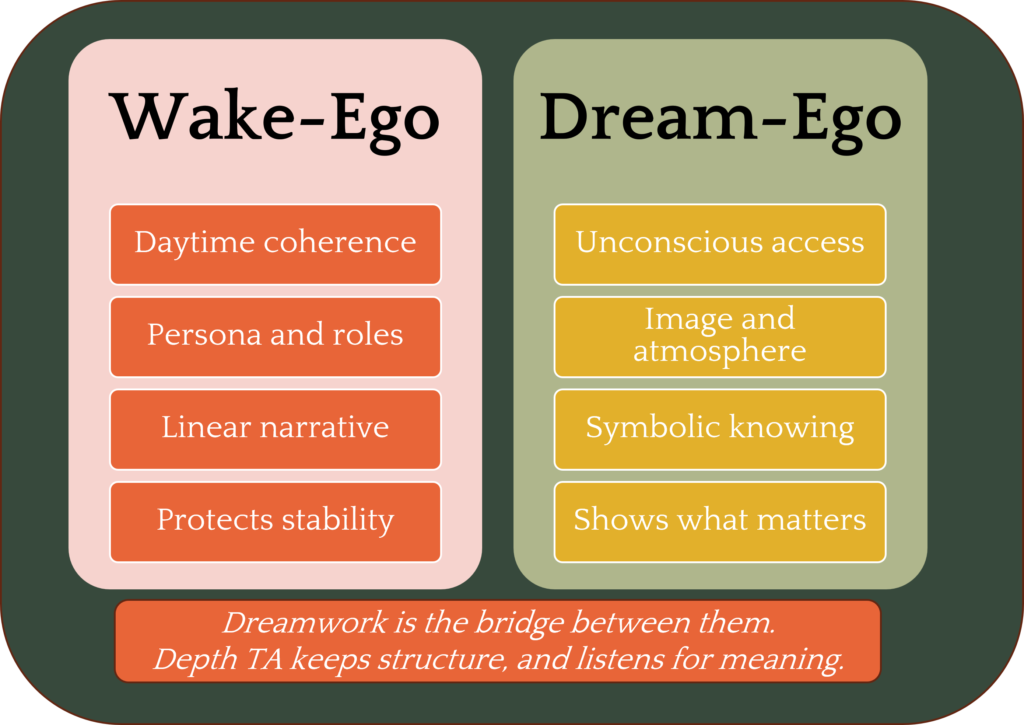
In Depth TA, it helps to distinguish the Wake-Ego from the Dream-Ego.
The Wake-Ego is the part of the psyche that navigates daytime life: morality, persona, role, social adaptation, and the need to remain coherent. It is shaped by script, by injunctions, by family loyalties, and by the identity we offer to others.
The Dream-Ego is different. It is the aspect of the psyche that can move inside the dream world with direct access to unconscious process. It allows a synthetic, imaginal contact with the deeper layers of the psyche—including collective themes that reach beyond personal biography.
Jung captures the spirit of this succinctly in Liber Novus:
“Dreams are the guiding words of the soul.”
— Jung, Liber Novus (The Red Book), p. 233.
The Dream-Ego is not “irrational” in the sense of meaningless. It is irrational in the sense of not being governed by the Wake-Ego’s rules. Yet it has direction. It often knows where the psyche needs to go.
Symmetry and dream logic: Matte Blanco’s contribution
Dreams do not obey ordinary logic. One thing can be another. A person can be a place. A room can be a childhood state. A stranger can be an inner figure. Time can collapse. Contradictions can coexist.
This is where Ignacio Matte Blanco’s theory of bi-logic becomes illuminating. In the symmetric mode of the unconscious:
“When the principle of symmetry is applied, all members of a set or of a class are treated as identical to one another and to the whole set or class…”
— Matte Blanco, The Unconscious as Infinite Sets (1998 [1975]), principle II2a.
And he makes the implication explicit:
“The individual does not stand for the class but, in contrast, class and individual … are one and the same thing.”
— Matte Blanco (1998 [1975]), p. 171.
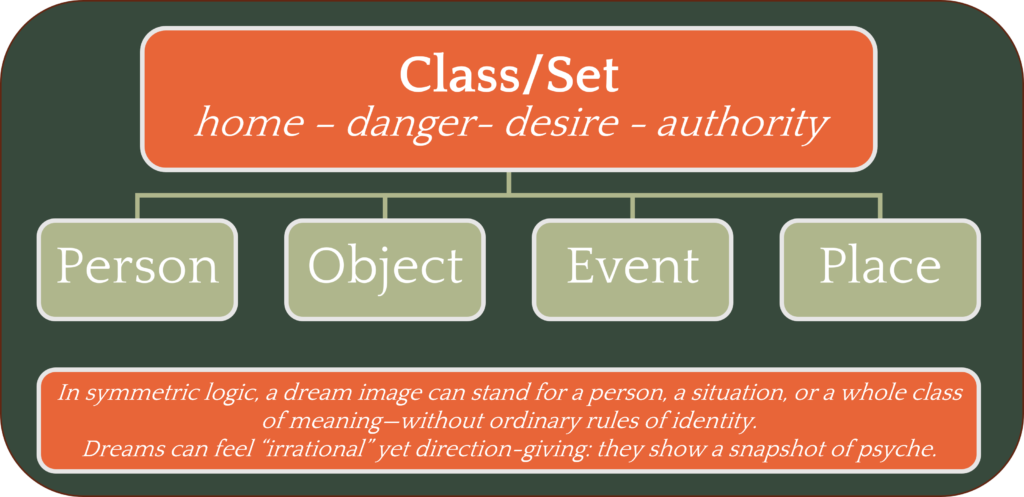
This is why dream images can operate as snapshots rather than explanations. They show the psyche where it is—without regard for physics, social permission, or moral presentation. They can be brutally truthful and strangely merciful at the same time.
The Dream-Ego, self-observation, and Bollas
Dreamwork is not only about what the dream “means.” It is also about how the psyche begins to observe itself. Christopher Bollas offers a language for this reflexive turn—how the self becomes an object of its own attention, often in ways that are subtle and easily missed.
Bollas writes:
“The way people interact reveals implied or tacit assumptions about their relation to the self as object…”
— Bollas, The Shadow of the Object (1987), pp. 48–49.
Dreams often enact this. In the dream, the Dream-Ego may feel acted upon, watched, chased, seduced, judged, abandoned, or protected. The psyche stages a drama in which the self becomes an object inside its own theatre. This is not pathology. It is one of the psyche’s ways of saying: Look. This is how you are being handled internally. This is how you are handling yourself.
Depth TA treats this as clinically significant because it points to something we teach later in training: the unconscious side of the ego. Not the ego as “pure consciousness,” but ego as a complex structure that can be partially unconscious to itself, with its own defences, identifications, and blind spots. Dreamwork becomes one of the most direct ways of encountering that.
I’ll name it gently here: in later stages of training, you will learn to work with the ego not only as the “centre of choice,” but also as a site where unconscious organisation quietly shapes perception, desire, and relational enactment.
Dreams as the psyche’s road toward individuation
From a Jungian perspective, dreams often orient the psyche toward individuation: the gradual process of becoming more fully oneself. Dreams can reveal what must be integrated, what has been split off, and what the Wake-Ego is resisting.
In Depth TA language, dreams often show where the script has become too narrow for the life trying to emerge now. They reveal the pressure points: where adaptation has become over-adaptation, where the persona has become a prison, where vitality has gone underground, where the internal Parent has become punitive, or where the Adult function has become brittle.
Dreams do not demand that you behave better. They invite you to become more whole.
How Depth TA works with dream material in training
In training, we work with dreams in ways that are clinically grounded, relationally attuned, and ethically paced.
- We start with the image, not the interpretation.
We stay close to the scene: what was felt, what was seen, what shifted. - We track the Dream-Ego’s position.
Where does the Dream-Ego have agency. Where does it lose it. What is it protecting. - We listen for what is trying to arrive in consciousness.
Not a single “answer,” but a movement: what wants to be noticed, owned, or integrated. - We connect the dream to TA structure without flattening it.
Ego states, script, strokes, and games can hold dream material with clarity, without turning it into a tidy moral lesson. - We prioritise pacing and containment.
Too much interpretation too early can feel invasive. Too little can feel dismissive. Dreamwork is an ethical act.
Further reading (from the Metis blog)
- Depth TA: Transactional Analysis Training That Listens Beyond Words
- Life Script in Transactional Analysis: Why We Repeat What Hurts
- Ego States in Transactional Analysis: A Beginner-Friendly Guide
- The Adult Ego State in Transactional Analysis: Choice, Ethics, and Clinical Presence
- Psychological Games in Transactional Analysis: How Relational Patterns Get Repeated
Book an Open Evening
If you are interested in dream analysis psychotherapy training, the best next step is often a direct encounter: meeting the institute, sensing the teaching culture, and asking what dreamwork looks like in practice.
Book an Open Evening: here
Depth TA: https://metisinstitute.co.uk/depth-ta/
Training pathway: https://metisinstitute.co.uk/training/
Bibliography
Bollas, C. (1987). The Shadow of the Object: Psychoanalysis of the Unthought Known. London: Free Association Books.
Jung, C. G. (1997). The Red Book: Liber Novus (S. Shamdasani, Ed.; M. Kyburz, J. Peck, & S. Shamdasani, Trans.). New York: W. W. Norton. (Quote: “Dreams are the guiding words of the soul,” p. 233.)
Jung, C. G. (1964). Civilization in Transition (Collected Works, Vol. 10) (R. F. C. Hull, Trans.). Princeton, NJ: Princeton University Press.
Matte Blanco, I. (1998). The Unconscious as Infinite Sets: An Essay in Bi-Logic. London: Karnac. (Original work published 1975).