Art and Creative Psychotherapy Training
What happens when we stop trying to get things right and simply allow ourselves to create?
There is something quite powerful about giving people permission to make a mess.
Creative psychotherapy training is about more than reading books and learning theories. Sometimes it begins with something as simple as picking up a paintbrush, choosing a colour and seeing what happens.
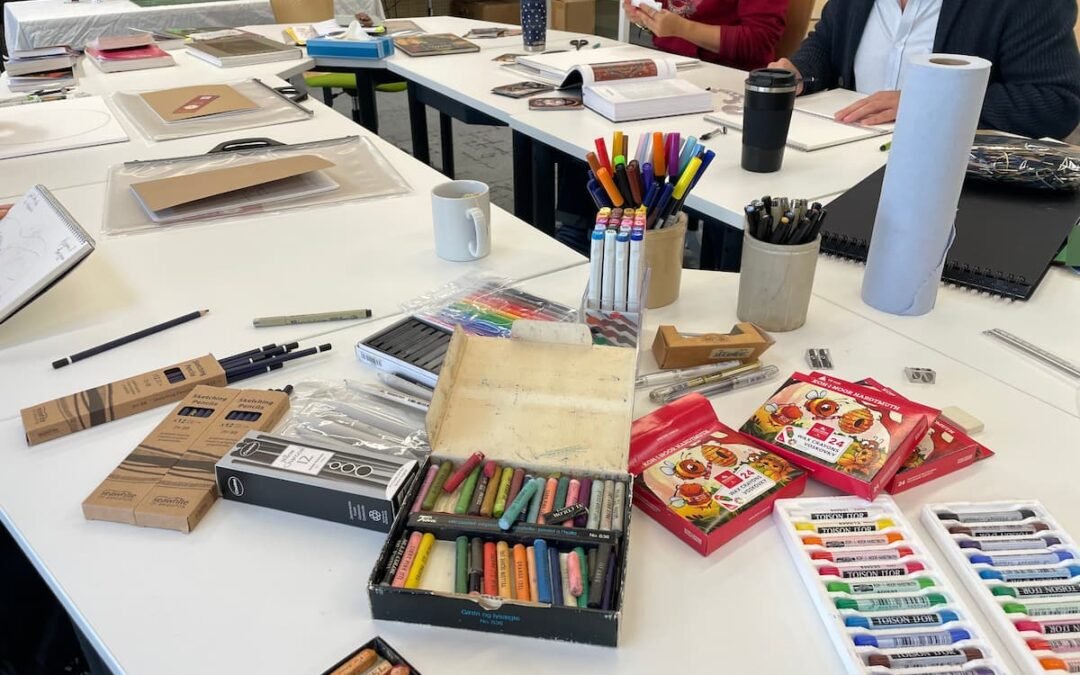
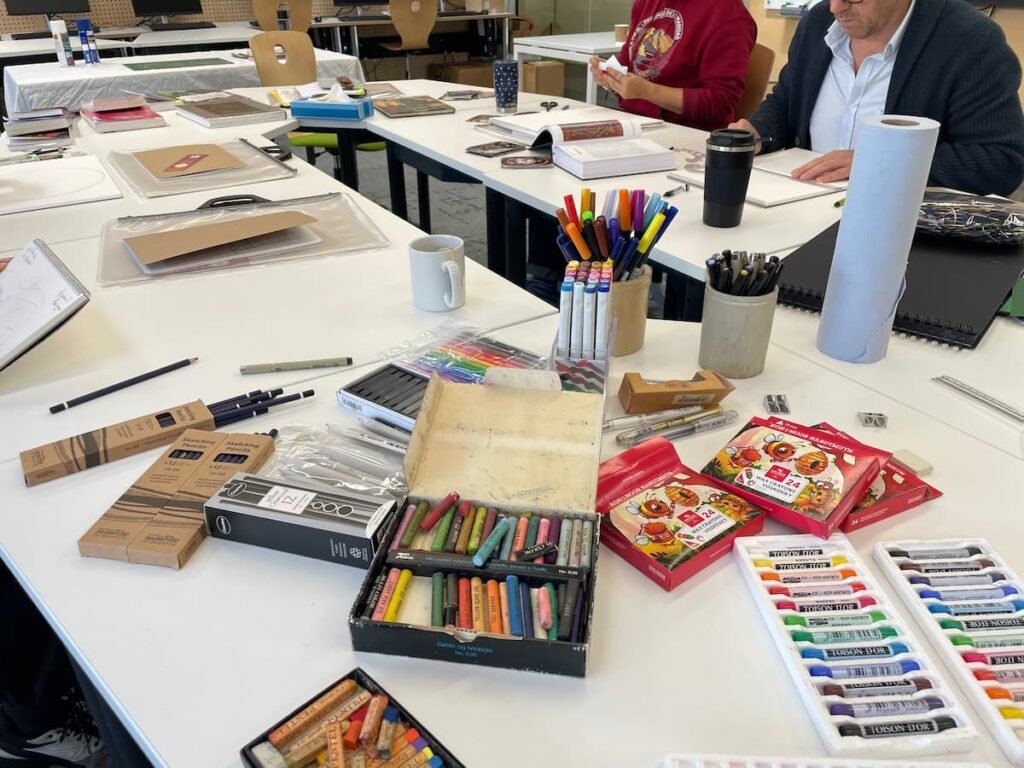
At our first art session at The Metis Institute, I was reminded just how much freedom there can be in allowing ourselves to create without worrying about the result.
It sounds easy, doesn’t it?
But for many of us, it really isn’t.
Somewhere along the way, we learn that things should look a certain way. We worry about getting things wrong, making mistakes or not being quite good enough.
So what happens when someone says, “There is no right or wrong here. Just have a go”?
Well, as we discovered, quite a lot!
A First Taste of Creative Psychotherapy Training
Our first art session brought together a wonderful mixture of emotions.
There was excitement, eagerness, curiosity, hesitation and a little worry. Some students couldn’t wait to begin. Others seemed less sure about where to start.
For some, having complete freedom to explore the materials felt almost overwhelming.
What were they supposed to make? Was there a right way of doing it? What if it didn’t look good?
There were moments when the experience came unexpectedly close to tears. Perhaps there was something deeply moving about being allowed to create without having to achieve anything.
Nobody needed to produce a masterpiece.
Nobody was being judged on their artistic ability.
And nobody had to be the best artist in the room.
We were simply exploring.
This is something I particularly enjoy about creative psychotherapy training. It gives people opportunities to discover things about themselves through experience, rather than always beginning with an explanation.
And what emerged from our first session was wonderfully varied.
What Does Your Psyche Look Like?
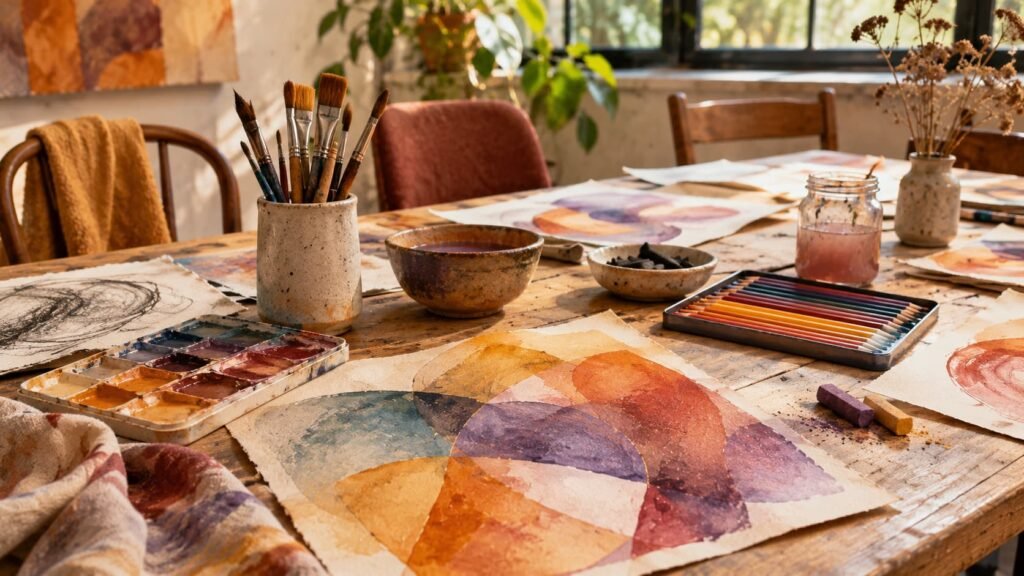
Our first-year psychotherapy students were invited to create a Psyche Map.
That might sound complicated, but the invitation was quite simple.
If you could make a picture of your inner world, what might it look like?
Would it be colourful? Would different parts be connected? Would some areas feel more familiar than others?
There was no template to follow.
Students could use colours, shapes, lines, textures or whatever materials caught their attention.
Some threw themselves into the process immediately. Others needed time to settle into it.
A few found themselves starting again, as though the first image had helped them discover something they wanted to explore further.
And that was absolutely fine.
Sometimes we don’t know what we want to express until we’ve started expressing it.
The resulting work was as individual as the people who made it.
Mandalas and the Many Parts of Ourselves
Our fourth-year students had a different invitation.
They were asked to explore mandalas, multiplicity and the many different aspects of ourselves.
In Jungian psychology, mandalas are often associated with wholeness and our search for a deeper understanding of ourselves.
But there was no expectation that students should create a beautiful, perfectly symmetrical circle.
Quite the opposite!
I wanted them to explore what might happen if they allowed their images to develop naturally.
After all, we’re not always neat and orderly inside, are we?
We can feel confident and uncertain, hopeful and frightened, independent and in need of support, sometimes all at once.
Art gives us another way of exploring these different parts without having to explain everything immediately.
And sometimes the results surprise us.
Jungian Psychology, Transactional Analysis and Creative Psychotherapy Training
At The Metis Institute, we bring together Transactional Analysis (TA) and Jungian psychology through an approach we’re developing called Depth TA.
These might sound like rather complicated subjects, but their ideas connect beautifully with creativity.
Transactional Analysis helps us understand how we relate to others, how we develop patterns throughout life and how we sometimes become stuck doing things in familiar ways.
It also places importance on spontaneity: our freedom to respond creatively rather than always following old expectations.
Think about what happens when someone picks up a paintbrush and immediately thinks, “I’m rubbish at art.”
Where did that belief come from?
Who decided what being good at art looks like?
And what might happen if we put that belief aside for a little while?
Jungian psychology brings another dimension.
Jung was fascinated by dreams, symbols, imagination and the parts of ourselves that we don’t always understand.
Jung himself explored images and painting as ways of understanding the unconscious. If you’re curious, you can read more about Jung’s use of art and imagination.
He recognised that images can sometimes express things we find difficult to put into words.
Perhaps you’ve had the experience of seeing a painting, hearing music or making something and feeling unexpectedly moved, without quite knowing why.
That’s the sort of experience we’re interested in exploring.
For us, creative psychotherapy training means allowing these different ways of understanding ourselves to work together.
We don’t always have to explain everything straight away.
Sometimes it’s enough to notice what happens.
The Freedom of Mark-Making
One of the loveliest things about art is that you don’t always have to make something recognisable.
Sometimes you can simply make marks.
A line, a scribble, a patch of colour or a shape that changes as you work.
Mark-making can be wonderfully freeing because it doesn’t require a plan.
You can experiment, change direction, add something, cover something up or begin again.
There is no perfect way to do it.
I particularly enjoy seeing what happens when people realise they don’t need to make their work look like anything.
The process can become playful, surprising and sometimes quite absorbing.
And that’s where some of the most interesting discoveries happen.
Learning to Look Without Judging
Another important part of our session involved learning to look at artwork without immediately deciding what it meant.
This is surprisingly difficult!
We’re so accustomed to evaluating things that we often jump straight into interpretation.
A dark colour must mean sadness. A strong line must mean anger. A messy picture must mean confusion.
But do we really know?
Instead, we practised simply noticing what was there.
The colours. The shapes. The textures. The spaces.
We tried to remain curious rather than rushing to explain.
This is also an important part of learning psychotherapy.
When someone shares something personal, it’s tempting to think we understand what they’re experiencing.
But we don’t always know.
And sometimes our assumptions can get in the way of really listening.
I don’t believe it’s my job to tell someone what their artwork means.
I’m interested in helping them explore what it means to them.
The person creating the artwork remains the expert on their own experience.
Do You Need Art Skills for Creative Psychotherapy Training?
Absolutely not!
Our art sessions aren’t about teaching people to draw perfect pictures.
You don’t need an artistic background, special techniques or expensive materials.
And you certainly don’t need to think of yourself as creative.
Sometimes the people who are most convinced they can’t make art discover just how enjoyable experimenting can be.
You also don’t have to be particularly academic to begin exploring psychotherapy training.
There is reading, studying and written work involved in becoming a psychotherapist. It’s a serious professional commitment.
But people learn in different ways.
Some learn through reading. Others through discussion, movement, practical exercises or making things.
At Metis, we want to make room for those different ways of learning.
Our creative psychotherapy training includes arts-based activities, movement, group work and psychological theory.
These creative sessions form part of our wider psychotherapy training programme. They are not a separate professional art therapy qualification. If you’re interested in the distinction, the British Association of Art Therapists explains what professional art therapy involves.
What matters is curiosity, openness and a willingness to learn.
Sometimes the Process Matters More Than the Picture
Looking back at our first art session, what stays with me isn’t just the artwork.
It’s the experience of people making it.
The person who wasn’t sure where to begin.
The student who became completely absorbed.
The decision to start again.
The little frustrations, surprises and unexpected discoveries.
There was something messy about the whole experience, but also something deeply rewarding.
Perhaps we underestimate how much we can learn when we’re not trying so hard to get everything right.
We can become more comfortable with uncertainty.
We can discover that mistakes aren’t necessarily disasters.
And we can find pleasure in simply having a go.
These are valuable experiences for anyone learning to become a psychotherapist.
After all, the people we work with won’t always arrive with clear answers or neatly organised experiences.
Sometimes our role is simply to accompany them while something begins to take shape.
Explore Creative Psychotherapy Training at Metis
If you’ve ever been curious about psychology, enjoyed making things or wondered whether working with people might be a meaningful direction for your life, I’d love you to discover what we’re doing at The Metis Institute.
Our creative psychotherapy training combines Transactional Analysis, Jungian psychology, art, movement and experiential learning.
You don’t need to be an artist.
You don’t need to have studied psychology before.
And you don’t need to arrive knowing exactly where your journey will take you.
We take our training seriously, but that doesn’t mean we can’t have fun along the way.
There’s room for laughter, curiosity, creativity and the occasional bit of mess.
Why not come along to one of our Open Evenings?
You can meet us, ask questions and discover whether this might be somewhere you’d enjoy learning.
Sometimes a new direction begins with something as simple as giving yourself permission to have a go.
Further Reading from our blog
Do I Need to Be Academic to Train in Psychotherapy?
Depth TA: Transactional Analysis Training That Listens Beyond Words
Ego States in Transactional Analysis: A Beginner-Friendly Guide
Frequently Asked Questions
What is creative psychotherapy training?
Creative psychotherapy training combines psychological theory with experiential methods such as art, movement and reflective exercises. At The Metis Institute, these approaches help students explore Transactional Analysis and Jungian psychology.
Do I need to be good at art?
Not at all. Our art sessions are about curiosity, experimentation and self-discovery, not artistic ability.
Is this the same as art therapy training?
No. Our psychotherapy programme incorporates arts-based learning, but it does not qualify students as art therapists. Art therapy is a separate regulated profession in the UK.
Do I need a university degree to apply?
A degree can be helpful, but it isn’t essential for applying to The Metis Institute. We value life experience, personal readiness and a willingness to learn.