

If you are searching for psychotherapy training not academic, you are probably holding a very human worry: “I’m not academic, so maybe I’m not cut out for this.” Sometimes the worry is about writing. Sometimes it is about theory. Sometimes it is the deeper fear of being exposed as an outsider in a world that feels full of confident professionals.
Here is the truth, stated plainly. Psychotherapy training is not academic in the same way as a university degree, but it does require sustained attention, study, and the willingness to be changed by relationship. The work is both intellectual and experiential. It involves reading and thinking, yes, but it also involves being with people—yourself, your peers, your clients—and tolerating complexity without rushing to fix it.
From a Transactional Analysis (TA) perspective, the question is not “Are you academic?”. The question is: can you learn, reflect, and stay present in relationship.
If you want to explore fit without forcing a decision too early, book an Open Day.
Book an Open Day: https://metisinstitute.co.uk/landing/
What people usually mean by “I’m not academic”
Most people who say “I’m not academic” are not saying “I can’t think.” They are saying one of these:
- “I don’t learn well through essays and exams.”
- “I’m worried I’ll sound stupid in a room of confident people.”
- “I haven’t studied formally for years.”
- “I’m more intuitive than theoretical.”
- “I’m better with people than with books.”
None of these automatically disqualify you from psychotherapy training. In fact, many excellent therapists come from non-academic backgrounds. They bring life experience, relational intelligence, and the ability to stay with people under pressure.
That said, training does involve theory, because theory offers structure. But theory is a map, not the territory. It guides attention. It does not replace experience.
Psychotherapy training is a craft, not only a curriculum
You can read about psychotherapy. You can understand concepts. But you cannot become a therapist through reading alone. Psychotherapy is learned through experience:
- being in groups, and noticing how you affect others,
- receiving feedback without collapsing into shame,
- learning to hold boundaries with care,
- being supervised, and thinking about your work ethically,
- being in personal therapy, and learning to stay with your own process.
Some trainees are strong writers. Others are strong in presence. Some can theorise beautifully. Others can sit in silence with a client without fleeing into technique. Training is the slow weaving of these capacities.
This is why a good institute does not only “teach content.” It forms practitioners.
If you want to see what we look for in applicants, read:
https://metisinstitute.co.uk/training/#entry-requirements
The TA-friendly answer: what matters more than being academic
From a TA perspective, what matters most is not academic identity. It is:
1) Capacity for self-reflection
Can you look at yourself honestly, without turning that honesty into self-attack.
2) Openness to feedback
Can you hear something difficult without needing to defend, perform, or disappear.
3) Relational steadiness
Can you stay in relationship when things become uncertain, emotional, or complex.
4) Commitment
Can you sustain attention over time—reading, practice, personal therapy—without relying on motivation alone.
5) Ethical orientation
Can you recognise power, vulnerability, and responsibility in human work.
These capacities are not “academic.” They are developmental. And they can be learned.
To understand how our training develops these capacities across the years, see:
https://metisinstitute.co.uk/training/
A depth perspective: different psyches, different gifts
From a depth psychology perspective, it helps to name something that is often missed in modern education discourse. There are different types of psyches, each with strengths and shadows. Some people are naturally conceptual. Others are naturally imaginal. Some think in frameworks. Others think in stories, images, gesture, atmosphere, and lived immediacy. Some write with precision. Others sense with accuracy.
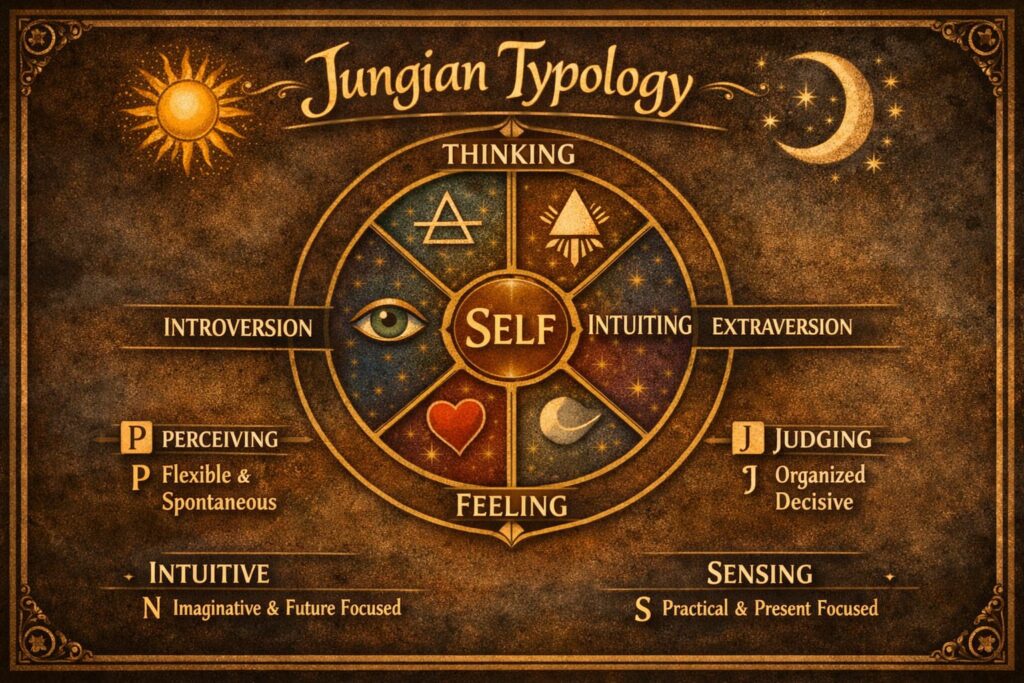
Jung’s typology is often flattened into personality quizzes, but its original purpose was clinical. Jung proposed that people differ in their attitude of consciousness (introverted or extraverted) and in their preferred psychological function (thinking, feeling, sensation, or intuition). These are not labels that imprison a person. They describe where consciousness tends to organise itself most reliably, especially under pressure.
What matters for psychotherapy training is the ethical implication. Each type brings gifts, and each has a predictable shadow. A conceptually strong mind can become detached, overly controlling, or prematurely certain. A feeling-led mind can become fused, avoidant of structure, or afraid of clear thinking. An intuitive psyche can become brilliant and ungrounded. A sensing psyche can become practical and resistant to inner complexity. Typology becomes useful when it stops being an identity, and becomes a map of what you need to integrate.
Jung is explicit that typology can never replace the individual:
“every individual is an exception to the rule.”
— Jung, Psychological Types (CW 6, 1921/1971), p. 484.
And he also names the developmental task: what we do well consciously, and what tends to run unconsciously:
“The superior function is… completely under conscious control… whereas the less differentiated functions are in part unconscious…”
— Jung, Psychological Types (CW 6), p. 327.
Psychotherapy training, at its best, supports exactly this. It strengthens what is conscious, and brings what is less developed into relationship and form, without turning the trainee into a single psychological style.
TA injunctions: when “I’m not academic” is really “Don’t Think”
Transactional Analysis gives a strikingly practical angle on this fear. TA script theory describes injunctions as early prohibitive messages a child internalises—often nonverbally—shaping what feels permitted in adulthood. One of the classic injunctions identified in redecision theory is “Don’t Think.” (Goulding & Goulding, 1976).

“Don’t Think” does not mean a person is unintelligent. It often means thinking became dangerous in the child’s environment. Perhaps curiosity was punished. Perhaps questioning authority provoked withdrawal. Perhaps the child was shamed as “stupid,” or mocked as “too clever,” or learned that thinking for themselves threatened belonging.
So when an adult says, “I’m not academic,” the hidden script message can be closer to:
- “If I think, I will be shamed.”
- “If I question, I will lose connection.”
- “If I speak up, I will be exposed.”
- “If I don’t know instantly, I am not allowed to learn.”
Psychotherapy training often softens this injunction—not by turning you into a scholar, but by helping you build a different internal permission: I can think, I can learn, and I can stay connected while I do.
This is also why psychotherapy cannot be learned only through books. Reading matters, but the deeper work is relational: learning to think under pressure without collapsing into shame or performance.
Theory is a map, and relationship is the territory
Theory matters. It gives you language, ethics, and an orienting framework. But psychotherapy happens in relationship. The real learning occurs when:
- your theory is tested by living encounters
- your certainty is softened by complexity
- your defences become visible in group process
- your voice becomes clearer through supervision
- and your presence becomes more reliable through personal work
A training that is all theory becomes brittle. A training that is all experience becomes ungrounded. A good training holds both.
Signs you are a good fit even if you’re “not academic”
You may be a good fit for psychotherapy training if you:
- feel pulled toward meaningful work, even if you doubt yourself
- can stay curious about your own patterns
- are willing to be taught and supervised
- can tolerate learning in a group
- want structure, but also want depth
- can commit to personal therapy as part of formation
And if you cannot yet do all of these, the question becomes: are you willing to grow into them?
Book an Open Day
If you are wondering whether you are “academic enough,” the best next step is often not more thinking. It is a direct encounter: meeting the institute, asking questions, and sensing whether the culture supports your learning.
Book an Open Day: here
Read entry requirements: https://metisinstitute.co.uk/training/#entry-requirements
Explore the training pathway: https://metisinstitute.co.uk/training/
Further readings
- TA101: What to Expect on a Transactional Analysis 101 Course
- Transactional Analysis Psychotherapy Training in the UK: The Route from TA101 to CTA
- Depth TA: Transactional Analysis Training That Listens Beyond Words
- Ego States in Transactional Analysis: A Beginner-Friendly Guide
- Can I Train While Working? A Realistic Guide for TA Psychotherapy Training
FAQs
Do I need a degree to train in psychotherapy?
Not always. Many training routes value life experience and readiness as much as formal education. Check the entry requirements for the specific programme. We do not require it.
How much reading is involved in psychotherapy training?
There is sustained reading, but it is integrated with practice, reflection, group process, and supervision. It is not “academic study” in isolation.
What if I struggle with writing?
Many trainees develop writing skills during training. What matters is willingness to learn and to receive feedback.
What matters most if I’m not academic?
Capacity for self-reflection, openness to feedback, ethical orientation, and the ability to stay present in relationship.
References
Goulding, R. L., & Goulding, M. M. (1976). Injunctions, Decisions, and Redecisions. Transactional Analysis Journal, 6(1), 41–48.
Jung, C. G. (1971). Psychological Types (Collected Works, Vol. 6). Princeton, NJ: Princeton University Press. (Original work published 1921).