

If you are searching for psychological games transactional analysis, you may already have a lived sense of what TA means by “games”. You might notice the same argument arriving with the same person, the same emotional ending, and the same aftertaste. You might watch yourself say the thing you promised you would not say. You might leave an interaction thinking, “How did we end up here again?”.
In Transactional Analysis (TA), psychological games are repetitive, patterned sequences of interaction that tend to produce a familiar emotional outcome. They are not “games” in the playful sense. They are strategies, often unconscious, that stabilise an internal world and keep relationships predictable, even when the outcome is painful (Berne, 1964). TA’s gift is that it makes these loops legible. Once you can see the pattern, you can begin to step out of it.
At The Metis Institute, we also bring a Depth TA lens to games, which means we listen for what is not yet conscious in the game, and how the psyche arranges “fate” when inner conflict is split off. Jung captured this with brutal clarity:
“The psychological rule says that when an inner situation is not made conscious, it happens outside, as fate. That is to say, when the individual remains undivided and does not become conscious of his inner opposite, the world must perforce act out the conflict and be torn into opposing halves.”
— C. G. Jung, Aion: Researches into the Phenomenology of the Self, “Christ: A Symbol of the Self”, pp. 70–71, para. 126 (Jung, 1959/1968). You can access this fundational book here.
TA would say something similar in different language. When an internal tension cannot be borne consciously, it will often be transacted relationally. The conflict is staged between people.
If you want the structured, internationally recognised introduction to these concepts, the first step is TA101, which you can begin exploring in our previous post.
Join TA101
To read more about our approach: https://metisinstitute.co.uk/depth-ta/
What are psychological games in Transactional Analysis?
In TA, a psychological game is a sequence of transactions that is:
- ends with a payoff (a familiar emotional conclusion, often unpleasant, that confirms a script belief) (Berne, 1964; Steiner, 1974)
- repetitive (it happens again and again)
- predictable (it has a familiar rhythm)
- partly unconscious (it is rarely chosen knowingly)
ends with a payoff (a familiar emotional conclusion, often unpleasant, that confirms a script belief) (Berne, 1964; Steiner, 1974)
Games are not simply “bad communication”. They are patterned relational solutions that once served a purpose. They manage anxiety, preserve attachment, protect identity, and stabilise an inner narrative.
Berne used games to show how people can feel as if they are freely conversing, while actually repeating a pre-set relational choreography (Berne, 1964). The person is not “lying”. The psyche is organising experience according to older templates.
Games, strokes, and the economy of recognition
One reason games persist is that they solve a recognition problem. TA’s concept of strokes names the human need for acknowledgement, attention, and contact (Berne, 1961; Steiner, 1974). When direct, nourishing strokes feel unsafe or unavailable, people may seek strokes through conflict, control, rescuing, or complaint.
Games can deliver strokes reliably, even if they are negative strokes. The “payoff” is not pleasure, but confirmation. The game confirms something the psyche already believes about self, other, and life.
This is why a game can feel both miserable and oddly inevitable.
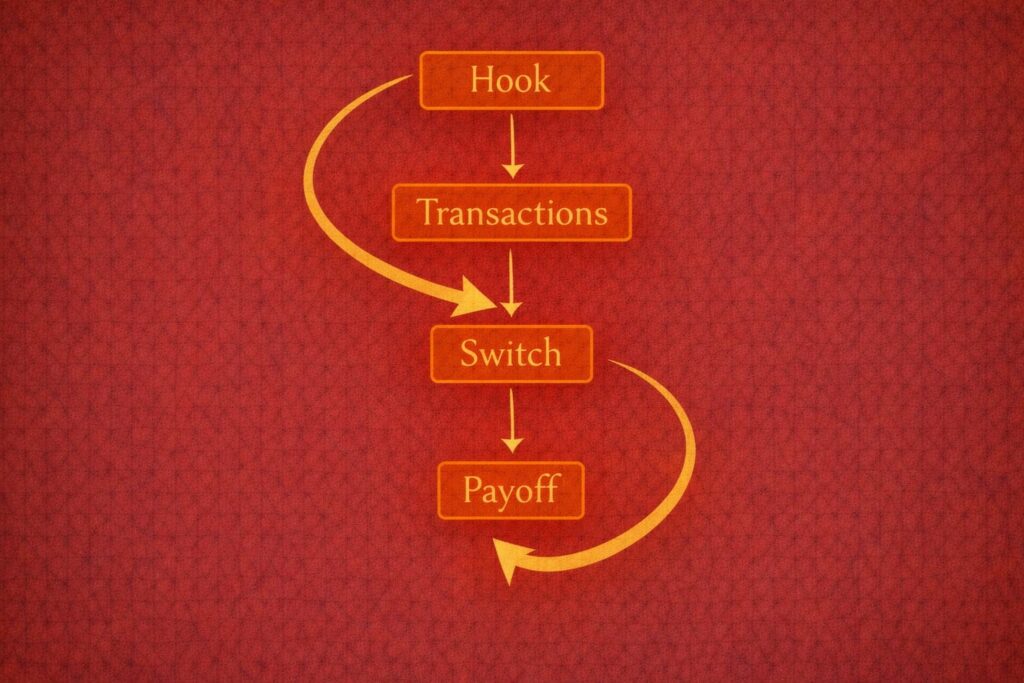
A simple anatomy of a game
Different TA writers present games with slightly different emphases, but an accessible structure looks like this:
- The hook: an invitation, bait, or opening move
- The series of transactions: a familiar back-and-forth
- The switch: a sudden shift in tone or position
- The payoff: a familiar emotional ending, such as humiliation, rage, abandonment, superiority, hopelessness, or righteousness (Berne, 1964)
The payoff often reinforces the script, as explained in a previous post, the deeper life patterning described in TA (Berne, 1961). Games are one of the ways the script gets enacted in a relationship.
Script and fate: where TA meets Jung
In TA terms, script is the long-term patterning of a life, shaped early, reinforced relationally, and often lived outside awareness (Berne, 1961). Games can be understood as script’s day-to-day “microdramas”. Script is the storyline, games are recurring scenes.

Jung’s statement about fate offers a powerful depth comparison. If inner conflict is not made conscious, the world “acts it out” (Jung, 1959/1968). Games are one way that acting-out happens. The psyche arranges an interpersonal theatre where the split-off opposite can appear, not as an inner tension, but as a conflict with another person.
In this sense, games are not random. They are meaningful repetitions. They reveal what is not yet integrated.
From a Depth TA view, the aim is not to shame games away. The aim is to bring the underlying conflict into awareness, so the compulsion to stage it externally reduces. The person becomes less governed by “fate”, and more able to choose.
Games and Jungian complexes: patterns with behaviour inside them
A further Jungian comparison is with the concept of complexes. Jung described complexes as emotionally charged clusters of images, memories, and associations that can behave like semi-autonomous psychic factors, influencing perception and action outside conscious control (Jung, 1969). Later analytical writers emphasised how complexes can “take over” behaviour, narrowing freedom, and shaping relationship in patterned ways.
This is one of the most helpful bridges between TA and Jungian thought: both recognise that human beings can be moved by internal structures they do not fully command.
In TA language, a game has a behavioural sequence. In Jungian language, a complex has behavioural consequences. When a complex is constellated, it does not simply produce a thought. It can recruit the body, the tone, the choices, and the relational stance. It can pull a person into predictable enactments.
From this perspective, a psychological game can be understood as the interpersonal expression of a constellated complex. The complex supplies the affect and compulsion, the game supplies the social choreography.
The clinical implication is crucial: you do not end a game by telling someone to “stop it”. You end a game by strengthening awareness, tolerating conflict internally, and developing new relational options.
Why we keep playing: the protective intelligence of games
People often hate their games, and yet defend them. This is not hypocrisy. It is protection.
Games often function to:
- avoid direct vulnerability
- manage dependency needs
- maintain identity (I am the good one, the competent one, the wounded one, the strong one)
- create predictability when intimacy feels risky
- confirm a script belief (“People always leave”, “No one understands”, “If I need, I’m shamed”)
A game may cost the person connection, but it protects them from a feared catastrophe. In depth terms, it prevents the psyche from facing a disowned opposite. In TA terms, it stabilises the script.
How to start stepping out of games
TA is practical. Even without becoming a psychotherapist, you can begin to change your relationship to games.
1) Learn your common payoffs
What is the familiar ending you arrive at? Is it resentment, defeat, righteous anger, loneliness, shame? Naming the payoff matters because it points to the script.
2) Identify the early hook
Most games can be interrupted early, before the switch. The hook is the moment to pause. Often it appears as a familiar impulse: to correct, to rescue, to appease, to withdraw, to accuse, to prove.
3) Strengthen Adult function
In TA, the Adult ego state supports reality testing, reflection, and choice (Berne, 1961). Strengthening Adult means learning to pause, track what is happening, and choose a response that is not simply the next line in the script.
Depth TA adds: Adult is not a cold analysis. It is consciousness in action, capable of bearing complexity without immediately discharging it into the other.
4) Tolerate the underlying feeling
If a game is a defence, then stepping out of it often exposes what the game was protecting against: grief, longing, fear, shame, tenderness. This is where change becomes real, and also where it can feel unsettling.
5) Practise a new transaction
The alternative to a game is often a direct, simple statement from the Adult. Clear request. Clear boundary. Clear acknowledgement. It can feel strangely unfamiliar at first, as if you are walking without your usual armour.
Why this matters in psychotherapy training
If you are training as a therapist, psychological games matter because:
- clients bring games into the room, often unconsciously
- therapists can be pulled into complementary roles (rescuer, persecutor, compliant child, controlling parent)
- the therapeutic relationship becomes a place where the script can repeat, or reorganise
Training involves learning to recognise the game, tolerate the pull, and respond ethically, rather than acting it out. This is not merely technique. It is formation: learning to remain present when the psyche invites you into familiar theatre. Explore our training options here.
If you want to understand how we teach TA with a depth lens, read: https://metisinstitute.co.uk/depth-ta/
Join TA101: the first step
Psychological games are a core topic in a TA101 course, alongside ego states, transactions, strokes, and life script. TA101 gives you the shared language to see patterns clearly and begin working with them.
Join TA101: https://metisinstitute.co.uk/ta101/
FAQs
Are psychological games in Transactional Analysis manipulative?
Not necessarily. Games are often unconscious relational strategies that manage anxiety, protect vulnerability, and confirm script beliefs. They can be harmful, but they are not always deliberately deceptive.
Is a game the same as conflict?
No. Conflict can be direct and honest. Games are patterned sequences with a hidden payoff, often ending in a familiar emotional conclusion.
How do I know I’m in a game?
You notice repetition, a familiar emotional drift, a sense of inevitability, and a “switch” after which the interaction escalates or collapses into a predictable ending.
How does Depth TA understand games differently?
Depth TA listens for the unconscious conflict being staged externally, and for the symbolic meaning of the repetition. In Jung’s terms, what is not conscious can appear as fate (Jung, 1959/1968).
Where should I start if I’m new to TA?
Start with a TA101 course, the standard introduction to Transactional Analysis, which includes games as a core concept. You can read more about it in our previous post.
References
Berne, E. (1961). Transactional Analysis in Psychotherapy. New York, NY: Grove Press.
Berne, E. (1964). Games People Play: The Psychology of Human Relationships. New York, NY: Grove Press.
Jung, C. G. (1968). Aion: Researches into the Phenomenology of the Self (2nd ed., R. F. C. Hull, Trans.). Princeton, NJ: Princeton University Press. (Original work published 1959)
Jung, C. G. (1969). A Review of the Complex Theory (R. F. C. Hull, Trans.). In The Structure and Dynamics of the Psyche (Collected Works of C. G. Jung, Vol. 8). Princeton, NJ: Princeton University Press. (Original work published 1934)
Steiner, C. (1974). Scripts People Live: Transactional Analysis of Life Scripts. New York, NY: Grove Press.