

If you are looking for transactional analysis psychotherapy training in the UK, you are probably not browsing casually. You are searching for a pathway that is coherent, reputable, and liveable. You want to know what the route actually looks like, how the stages build, and what kind of therapist this training forms you into.
Transactional Analysis (TA) attracts people who want psychological clarity without reduction: a model that is relational, practically usable, and capable of holding complexity. For serious applicants, the key questions are usually the same. Where do I start? How do I progress? What counts as recognised training? And what does the CTA pathway actually involve?
This guide outlines the route from TA101 through to CTA (Certified Transactional Analyst). Our training is aligned with UKATA and EATA standards, and designed to support progression towards recognised TA training routes, including CTA.
Step 1: TA101 — the first doorway
In the UK and internationally, TA101 is the standard entry point into formal TA training. It is the internationally recognised introduction to Transactional Analysis, taught to a standardised syllabus. TA101 gives you a shared language for core concepts, and it allows you to test fit before committing to longer-term training.
A strong TA101 does two things at once:
- It gives you practical tools you can apply immediately: ego states, transactions, recognition patterns, repeating relational dynamics.
- It introduces the deeper logic of TA: why patterns repeat, how scripts form, and how relational change becomes possible
Berne’s view of communication was disarmingly direct:
“Communication will proceed as long as transactions are complementary.”
— Berne (1964, p. 24)
TA101 is where you begin to see what becomes complementary, what becomes crossed, and how quickly the relational field reorganises when you respond from a different internal place.
Join a TA101: here
Step 2: Foundation training — building the shared language
After TA101, the next stage consolidates learning so TA becomes more than helpful concepts. It becomes a disciplined framework: a way of thinking, listening, and making clinical sense.
At this stage, students deepen their understanding of:
- Ego states as organising systems of self and relationship
- Transactions and the structure of communication
- Strokes, recognition patterns, and the relational economy of attention
- Script as long-term life patterning
- Games as repeating relational sequences with predictable payoffs
- The ethical stance of the practitioner in relationship
- This stage is where the training begins to shape presence, not only knowledge. Study, reflection, and group process become part of clinical formation. At The Metis Institute, this is covered in the first year of training.
Training pathway: https://metisinstitute.co.uk/training/
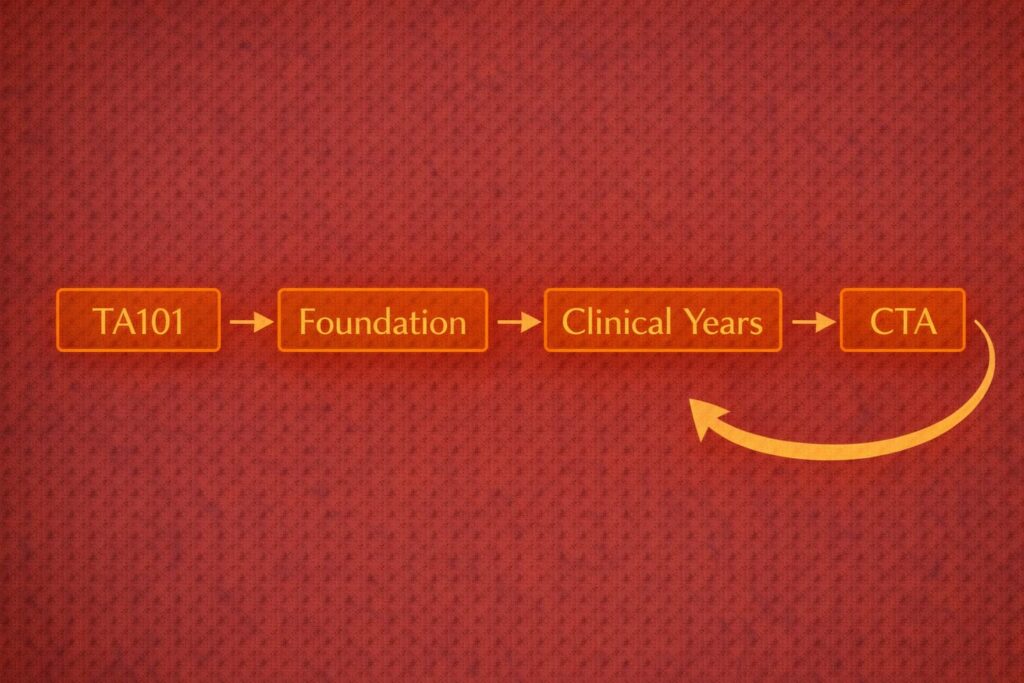
Step 3: Psychotherapy training — from theory into practice
As training progresses, the task shifts from theory acquisition into applied clinical formation. Psychotherapy training is not simply learning “how to do therapy”. It is becoming the kind of practitioner who can work ethically in complexity, hold ambiguity, and stay relational when the work becomes emotionally charged.
Across the further 3 training years, students are expected to develop:
- reflexive awareness of the therapist’s position, power, and subjectivity
- a capacity to tolerate uncertainty without rushing to fix
- the ability to think in patterns, not isolated events
- supervision-informed practice and ethical accountability
- clinical presence: steadiness, responsiveness, and psychological depth
For many career-changers, this is where meaning becomes concrete. The training is no longer an idea. It becomes a lived reorientation of how you listen, respond, and hold human suffering.
Step 4: The CTA pathway — what it is and what it consolidates
CTA stands for Certified Transactional Analyst. It is a recognised professional qualification within TA, typically awarded through a process that includes a written component and an oral examination. The CTA pathway is not simply a hurdle to clear. It consolidates identity and competence: a way of demonstrating that your clinical thinking, ethics, and practice are held within the wider TA field.
A CTA pathway commonly includes:
- a training contract with a principal supervisor
- supervised clinical practice and ongoing professional development
- preparation for written work and case material
- preparation for the oral exam
- sustained commitment to ethical practice and reflective enquiry
Many trainees experience CTA as an apprenticeship. It refines clinical voice and strengthens professional identity: not only “I have studied psychotherapy”, but “I can articulate what I do, why I do it, and how I practise responsibly within the TA community”. At The Metis Institute, we foster a community-driven ethos.
CTA pathway: here
Why “aligned with UKATA and EATA standards” matters
When you are choosing transactional analysis psychotherapy training, credibility matters. You want to know your training is structured within recognised professional frameworks, and that your pathway makes sense in the wider TA community.
That is why our wording is precise. We say our route is:
This signals training held within a wider professional ecology, rather than invented in isolation. It also protects applicants from vague promises. In serious training, words matter.
Depth TA at The Metis Institute
At The Metis Institute, we teach Transactional Analysis through a lens we are actively developing: Depth TA. Our aim is to enrich the clarity of TA with the symbolism and imaginal intelligence of Jungian theory, creating an integrated and unified system that allows our students to offer a richer therapeutic experience—one that is both clinically precise and psychologically deep.
ciplined map of ego states, script, games, and relational patterns. Depth psychology extends that map into the unseen dynamics that shape the ego and motivate it: symbolic material, archetypal themes, unconscious loyalties, and the ways meaning moves through image, body, and relationship.
Christopher Bollas named a kind of inner knowing that fits this territory precisely:
“…that which is known but not yet thought (what I term the unthought known)…”
— Bollas (1987 pag.15)
Depth TA trains therapists to meet this kind of knowledge without forcing it into premature explanation. It develops the capacity to listen beyond the spoken narrative, while staying ethically grounded and clinically clear.
If you want to know more, book one of our free workshops, “What is Depth TA?”
Depth TA: https://metisinstitute.co.uk/depth-ta/

Why change can feel messy
Serious psychotherapy training changes the person doing it. That means development rarely moves in a straight line. Fordham’s developmental thinking is useful here because it normalises rhythm rather than perfection:
“Further deintegrations and reintegrations… [lead to] the progressive enrichment of the self.”
— Fordham (1985)
In practice, this means that periods of uncertainty, emotional weather, and temporary disorganisation can be part of genuine reorganisation—if they are held with pacing, containment, and reflective support.
Exams, conferences, and community spirit
One psychologically important aspect of the CTA pathway is that qualification is not only an individual achievement. In many TA contexts, the CTA oral examination process takes place during professional conferences. This matters because it situates assessment within the community.
A conference is the living culture of TA: peers, supervisors, examiners, and professional identity held in a wider field. When exams are held in that context, qualification becomes more than a private milestone. It becomes a rite of passage—witnessed, supported, and situated within the ethics and language of the profession.
For serious applicants, this is often reassuring. You are not training alone. You are entering a professional world.
The two best next steps
If you are serious about transactional analysis psychotherapy training, the next two steps are usually the most useful:
1) Join TA101
If you are new to TA, TA101 is the first step into the shared language that supports everything else.
Join TA101: here
2) Explore progression and apply
If you already have TA101 and want to understand the route beyond the introduction, begin here:
Training pathway: https://metisinstitute.co.uk/training/
CTA pathway: here
Further Reading
Further reading (from the Metis blog):
- TA101: What to Expect on a Transactional Analysis 101 Course (ideal if you want to start)
- What Is Transactional Analysis (TA)? A Beginner Guide (the core map in plain language)
- Life Script in Transactional Analysis: Why We Repeat What Hurts (how long patterns form)
- Psychological Games in Transactional Analysis: How Relational Patterns Get Repeated (how patterns play out between people)
- Ego States in Transactional Analysis: A Beginner-Friendly Guide (Parent, Adult, Child, with Depth TA nuance)
- Depth TA: Transactional Analysis Training That Listens Beyond Words
FAQs
What is the first step in transactional analysis psychotherapy training?
For most people, the first step is TA101, the internationally recognised introduction to Transactional Analysis.
Do I need TA101 before I can progress towards CTA?
In recognised TA training routes, TA101 is widely treated as the prerequisite foundation before further formal training and CTA progression.
What is the CTA pathway?
CTA (Certified Transactional Analyst) is a recognised professional qualification in TA, typically involving supervised practice and written and oral examinations.
How do I decide if this path is right for me?
Start with TA101 if you are new to TA. If you already have TA101, attend an Open Day or enquire so you can ask practical questions about fit, readiness, and progression.
Bibliography
Berne, E. (1961). Transactional Analysis in Psychotherapy. New York, NY: Grove Press.
Berne, E. (1964). Games People Play: The Psychology of Human Relationships. New York, NY: Grove Press.
Bollas, C. (1987). The Shadow of the Object: Psychoanalysis of the Unthought Known. London: Free Association Books
Fordham, M. (1985). Explorations into the Self. London: Academic Press.