
If you are searching for transactions in transactional analysis, you are probably trying to understand a familiar moment: a conversation that starts one way and ends somewhere else entirely. A simple question becomes an argument. A neutral comment lands like an attack. A helpful suggestion triggers withdrawal. You leave thinking, “That is not what I meant,” and yet the interaction has already hardened into a pattern.
Transactional Analysis (TA) offers a remarkably precise way to understand this: it studies the transaction—the basic unit of communication. In TA, what matters is not only what is said, but from which ego state it is said, and what ego state it invites in response (Berne, 1961). If you want to know more about Ego States, read our post on them. When the invitation and the response align, communication tends to flow. When they do not, conversations often break down.
If you want to learn these concepts properly, the first step is TA101.
Join TA101: here
Training pathway: https://metisinstitute.co.uk/training/
What is a transaction in Transactional Analysis?
A transaction is an exchange between two people: a stimulus and a response. It can be a sentence, a glance, a tone, a pause, a sigh. TA treats transactions as meaningful, patterned, and observable.
Crucially, every transaction happens between ego states:
- Parent, Adult, or Child in one person
- inviting Parent, Adult, or Child in the other (Berne, 1961)
This is why people can argue about “content,” when the real conflict is about the level of the interaction.
Complementary transactions: when communication flows
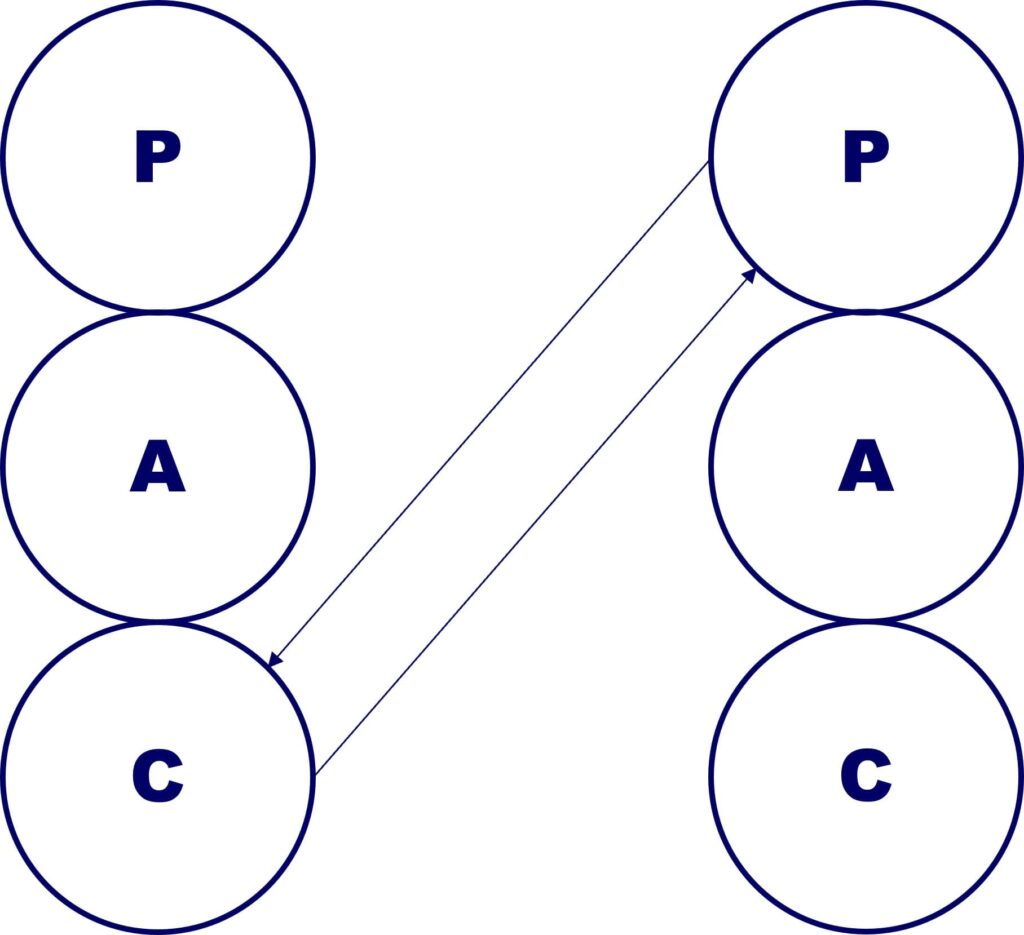
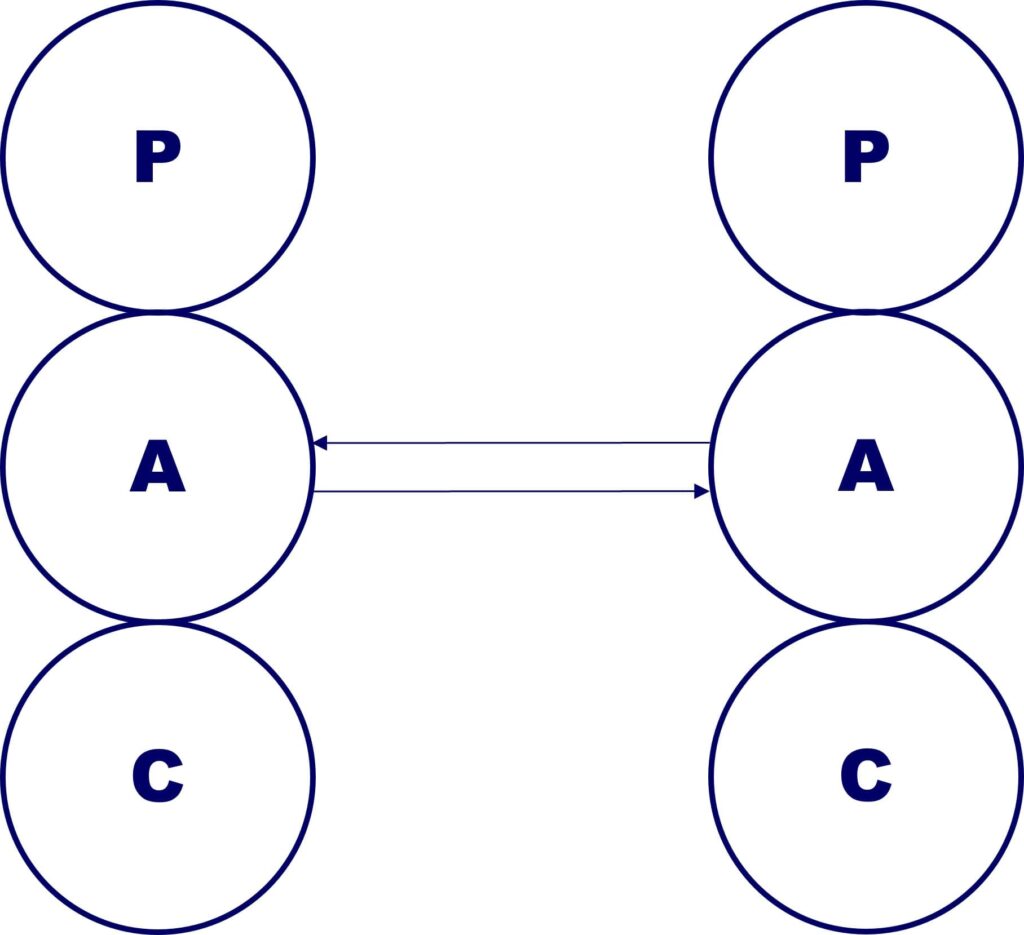
A complementary transaction is one in which the response comes from the ego state that was invited. These transactions tend to feel smooth, predictable, and coherent.
Examples:
- Adult → Adult: “Can we look at what happened and decide what to do?”
“Yes. Let’s clarify the facts.” - Parent → Child (functional): “Here are the steps; follow them in this order.”
“Okay. I will.” - Child → Parent (appropriate): “Can you help me?”
“Yes. Tell me what you need.”
Eric Berne expressed this plainly:
“Communication will proceed as long as transactions are complementary.”
— Berne, Games People Play (1964), p. 24.
Complementary does not always mean healthy. A Parent–Child dynamic can be complementary and still be oppressive or regressive. But complementary transactions tend to keep the conversation going.
Crossed transactions: when conversations break down
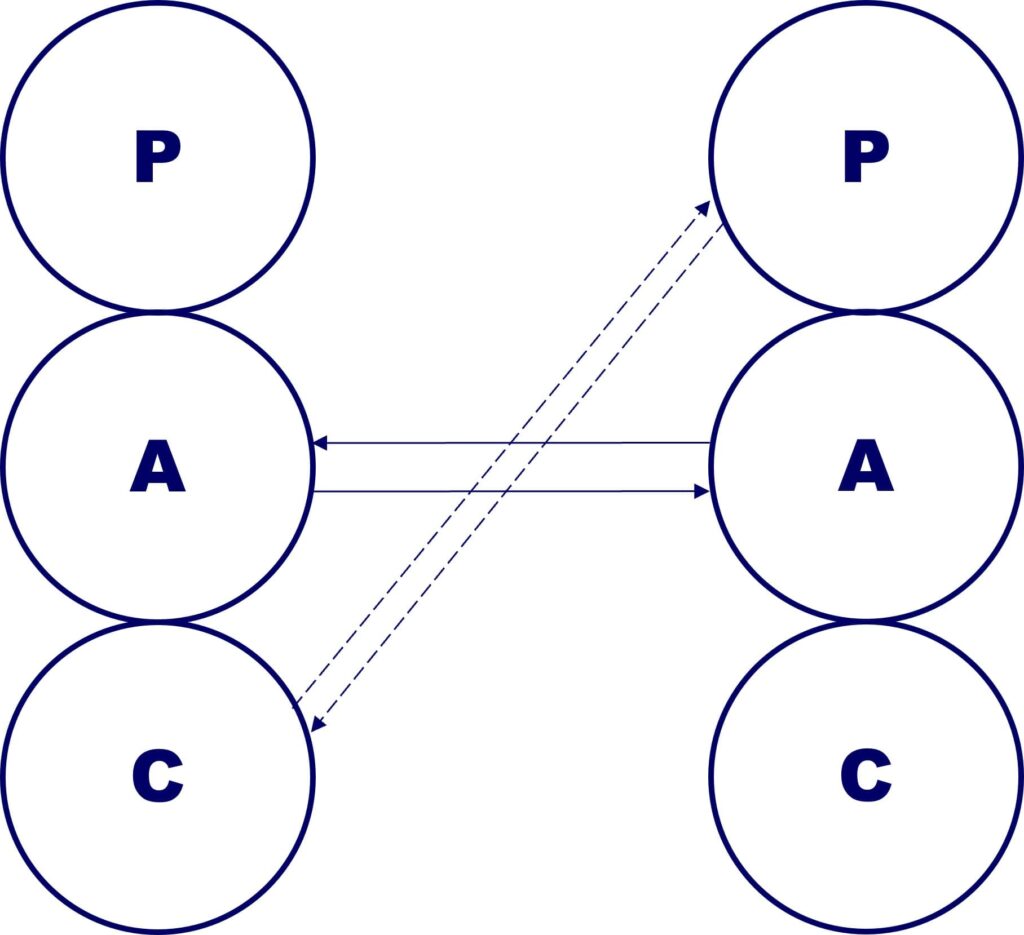
A crossed transaction happens when the response comes from a different ego state than the one that was invited. This is one of the most common reasons conversations derail.
Example:
- Person A (Adult): “Could we talk about what happened yesterday?”
- Person B (Child): “Why are you always blaming me?”
Example:
- Person B (Child): “Why are you always blaming me?”
- Person A (Adult): “Could we talk about what happened yesterday?”
The response does not meet the Adult invitation. It shifts the level of the interaction, often introducing threat, shame, or defence. At that point, the conversation can collapse into:
- accusation and counter-accusation
- withdrawal
- escalation
- or a “game” pattern
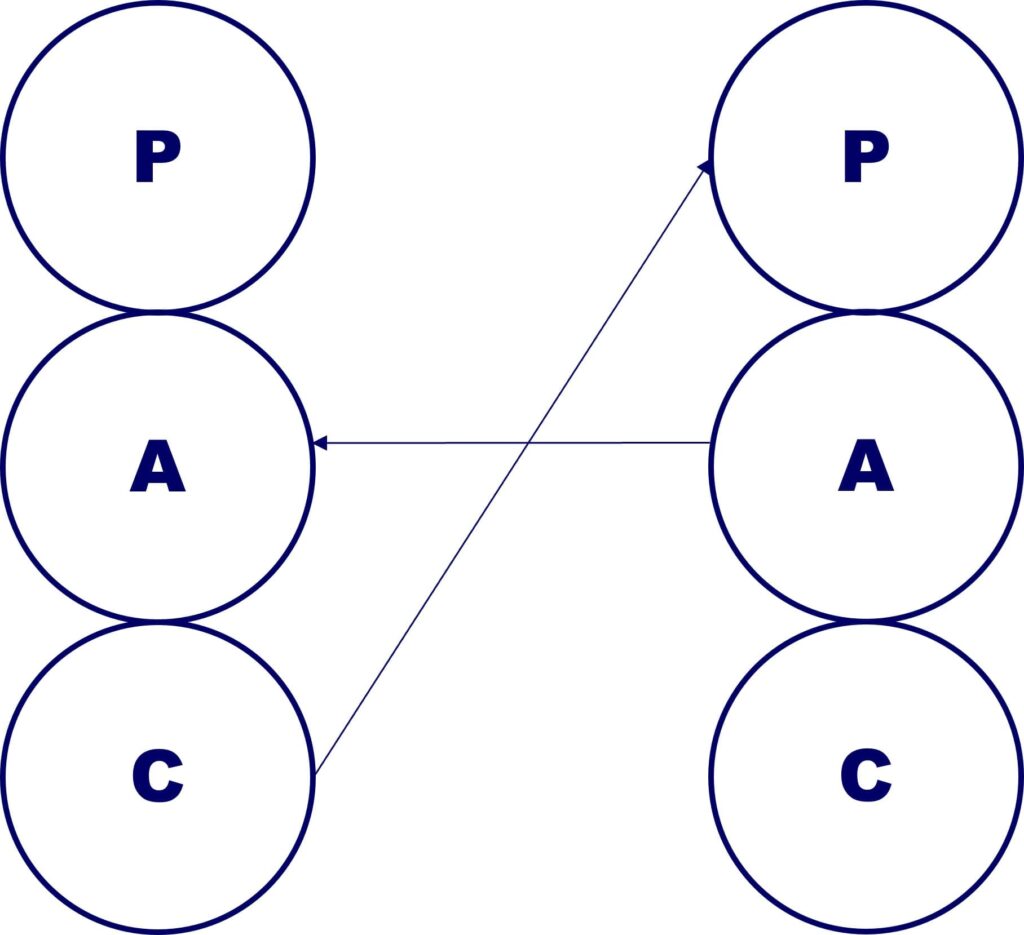
Crossed transactions are not failures. They are signals. Something in the relational field has become too charged for Adult-to-Adult contact.
The hidden layer: ulterior transactions
TA also describes ulterior transactions, where there is a social-level message and a psychological-level message happening at the same time. On the surface, the words seem reasonable. Underneath, the transaction carries a different invitation.
Example:
- Social message (Adult): “Are you free later?”
- Psychological message (Child): “Prove you care.”
Ulterior transactions often feed games and repeating relational sequences (Berne, 1964). They are one reason people can feel confused after an interaction: the surface makes sense, but the emotional outcome doesn’t.
Why conversations break down in real life
Most breakdowns happen for one of these reasons:
1) Threat to identity
When someone feels criticised, exposed, or shamed, they may leave Adult and move into Parent attack or Child defence.
2) Attachment panic
When a conversation touches fear of abandonment, rejection, or not mattering, people often shift state quickly. The body reacts before the mind can explain.
3) Power dynamics
When authority, hierarchy, or vulnerability is present, transactions can become loaded. What is “neutral” in one context is threatening in another.
4) Unspoken needs
When needs cannot be asked for directly, communication becomes indirect. The result is often crossed or ulterior transactions.
TA helps because it makes these shifts visible early, before escalation becomes inevitable.
A Depth TA emphasis: masks, fear of being found out, and empathic confrontation
In Depth TA, we pay close attention to a specific fear that sits underneath many crossed transactions: the fear of being found out—not adherent to the person we offer society and others. Many conversations break down at the moment a mask is threatened. Not because the person is “fake,” but because the mask is an adaptation: a carefully crafted way of staying safe, loveable, employable, or acceptable.
This matters especially in psychotherapy.
A therapeutic conversation can break down when:
- the therapist reveals too much too early, before the client has enough safety to metabolise it
- the therapist fails to attune to the client’s inner truth, and speaks to the persona rather than the psyche
Depth TA treats rupture not as error alone, but as meaningful information: what is being protected, what cannot yet be spoken, what is too exposed.
Confrontation, when done empathically, has a particular power. It can lift the mask without humiliating the person. It can name what is happening in the relationship while maintaining safety. It does not tear defences away. It invites the psyche to loosen them voluntarily.
Empathic confrontation is one of the places where TA’s clarity and depth psychology’s sensitivity meet. The aim is not to win the conversation. The aim is to return to truth.
How to repair a crossed transaction
When a conversation breaks down, you can often repair it by returning to Adult in one of three ways:
1) Name the level shift
“I think we’ve moved from problem-solving into blame. Can we slow down?”
2) Acknowledge impact
“I hear that landed as criticism. That wasn’t my intent, and I want to understand what it touched.”
3) Make a clean request
“What I need is clarity about X. Are you willing to look at that with me?”
In therapy, repair is part of the work. The therapeutic relationship becomes a place where new transactions are practised, and new outcomes become possible.
Join TA101
Complementary and crossed transactions are core material in TA101, alongside ego states, script, games, and recognition patterns. If you want to learn transactions transactional analysis in a structured, internationally recognised introduction, TA101 is the first step.
Join TA101: here
Explore the training pathway: https://metisinstitute.co.uk/training/
FAQs
What are transactions in Transactional Analysis?
Transactions are the basic units of communication: an exchange of stimulus and response between ego states (Parent, Adult, Child).
What is a complementary transaction?
A complementary transaction is when the response comes from the ego state invited, so communication tends to flow.
What is a crossed transaction?
A crossed transaction is when the response comes from a different ego state than the one invited, often causing a conversation to break down.
Can crossed transactions be repaired?
Yes. Often by slowing down, naming the shift, acknowledging impact, and returning to a clean Adult-to-Adult request.
References
Berne, E. (1961). Transactional Analysis in Psychotherapy. New York, NY: Grove Press.
Berne, E. (1964). Games People Play: The Psychology of Human Relationships. New York, NY: Grove Press.