
In Transactional Analysis, the Drama Triangle is one of the clearest models for understanding repetitive relational conflict. It names three familiar positions: Rescuer, Persecutor, and Victim. These are not fixed identities, but shifting roles in a psychological drama. What makes the triangle so powerful is not simply that these roles exist, but that people can rotate through them with remarkable speed, often believing all the while that they are only reacting to what someone else has done.
Stephen Karpman introduced the model through script drama analysis, locating it within recurring role reversals and the patterned emotional switches that make conflict feel theatrical, repetitive, and fatefully familiar (Karpman, 1968).
From a Depth TA perspective, this is one reason the triangle is so compelling. These are not merely social positions. They are mythic roles. They belong to the deep grammar of human storytelling. They appear in fairy tales, fables, legends, and family scripts. They are recognisable because they are older than any individual conflict. If you want to know more about Depth TA, please go here.
What is the Drama Triangle in Transactional Analysis?
The drama triangle transactional analysis model describes a recurring pattern in which people move between three roles:
- Victim: feels oppressed, helpless, wronged, cornered, unseen, or unable to act.
- Rescuer: intervenes, fixes, protects, soothes, or takes over, often without being asked.
- Persecutor: criticises, controls, blames, shames, punishes, or dominates.
In practice, these roles rarely stay still. The Rescuer who is not appreciated may flip into Persecutor. The Victim who finally protests may become Persecutor. The Persecutor who is confronted may suddenly present as Victim. Karpman’s original article is foundational precisely because it shows how quickly the triangle reorganises itself through switches in position and emotional logic (Karpman, 1968).
That movement is why the triangle is called a drama. It is not static. It depends on reversal.

Why it is a triangle, and why that matters
The Drama Triangle is a drama partly because it is a triangle and not a stable, balanced form. It has tension, but not integration. It creates movement, but not containment.
A depth reading can sharpen this. Jung repeatedly associated mandala symbolism with psychic ordering and with a quaternity, a fourfold pattern that tends toward wholeness rather than fragmentation (Jung, 1972). By contrast, the triangle conveys instability, incompleteness, and dramatic momentum. It does not hold a centre well. It intensifies relational polarity instead.
So the Drama Triangle is not dramatic only because the feelings are large. It is dramatic because it is structurally unbalanced.
The mythic and fairy-tale dimension
This is where the depth perspective becomes especially rich.
As von Franz (1996) wrote:
“Fairy tales are the purest and simplest expression of collective unconscious psychic processes” (p. 1).
That is a particularly strong lens through which to read the Drama Triangle. The roles of Rescuer, Persecutor, and Victim are not only interpersonal manoeuvres. They are archetypal simplifications. The cruel stepmother, the wounded innocent, the punishing king, the false saviour, the devouring wolf, the helpless child: these figures endure because they condense psychic life into recognisable dramatic forms.
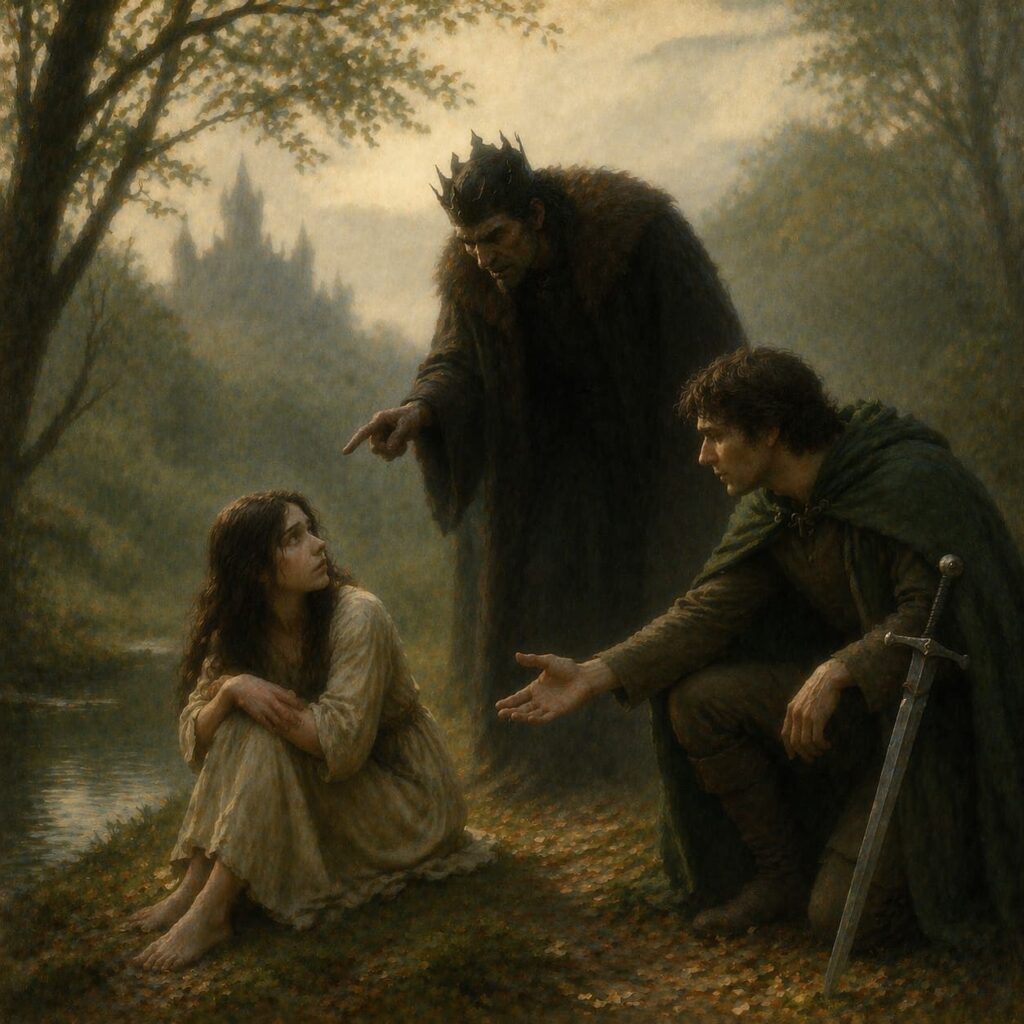
Campbell makes a related move when he writes:
“Myth is a public dream, dream is a private myth” (Campbell, 1991, p. 48).
That line belongs naturally here. The Drama Triangle lives both publicly and privately. Publicly, it appears in story, culture, and collective fantasy. Privately, it appears in intimate relationships, inner conflict, transference, and script. The same structure can govern a marriage, a workplace struggle, a family argument, or an inner emotional sequence.
You could say that the Drama Triangle is one of the ways a private myth becomes enacted between people. Read out blog on dreams to go deeper.
Why these roles are so seductive
Each role offers a hidden psychological payoff.
The Victim is relieved of responsibility, at least temporarily, because helplessness seems to explain everything.
The Rescuer avoids their own vulnerability by becoming necessary to someone else.
The Persecutor avoids helplessness by moving into control, certainty, blame, or superiority.
This is why people do not simply “fall into” the triangle by accident. They are often drawn into it because each position protects something. From a TA perspective, these roles can become part of a game system. From a depth perspective, they are also defences against shame, dependency, aggression, guilt, grief, and psychic exposure.
The same early pressure patterns discussed in our article on Drivers in Transactional Analysis.
A Berne lens: frogs, princes, and script
Berne’s fairy-tale language belongs here too. In Principles of Group Treatment, he writes:
“Every human being is born a prince or a princess; early experience convinces some that they are frogs” (Berne, 1966, p. 290).
That line matters for the Drama Triangle because the roles are often frog-skin adaptations. They are not the deepest truth of the person. The Rescuer is often a frightened psyche that discovered that being needed brought safety. The Persecutor is often a terrified psyche that found attack easier than exposure. The Victim may carry genuine injury, but become organised around an adaptation in which agency feels dangerous.
So stepping out of the triangle is not about becoming cold, detached, or invulnerable. It is about recovering something less defended and more alive.
How the roles show up clinically
The triangle appears wherever there is chronic repetition, moral inflation, and fast role-switching.
A therapist may feel pulled to Rescue a client from pain, then become inwardly irritated and shift into Persecutor, then feel guilty and collapse into Victim.
A couple may arrive with one partner presenting as the obvious Victim and the other as the obvious Persecutor, only for the dynamic to reverse repeatedly as the session unfolds.
A family system may organise around a designated vulnerable person, while another member becomes the permanent fixer, and a third carries the aggression for the group.
And because these positions are archetypal, they often appear in countertransference with unusual force. The triangle is not just thought. It is felt.
What keeps people inside the triangle
People stay in the Drama Triangle because the roles feel morally clear.
The Victim feels innocent.
The Rescuer feels good.
The Persecutor feels justified.
That moral clarity is part of the trap.
The deeper reality is usually more complex. The Rescuer may be intrusive. The Victim may be disowning agency. The Persecutor may be carrying disavowed terror or shame. None of this removes actual harm or actual suffering. It means, rather, that the triangle simplifies psychic life into dramatic positions that feel easier to inhabit than ambiguity.
And ambiguity is one of the thresholds of growth.

How to step out of the Drama Triangle
Stepping out does not mean becoming passive or indifferent. It means refusing the hidden bargain of the role.
For the Victim, the movement is toward agency:
What can I feel, name, choose, ask for, or do, even if I am frightened?
For the Rescuer, the movement is toward boundaried care:
Can I stay present without taking over? Can I help without needing to be indispensable?
For the Persecutor, the movement is toward clean aggression and accountability:
Can I speak directly without humiliating, dominating, or discharging my own anxiety into someone else?
In all three cases, the deeper movement is from role to relationship.
That usually means slowing the process enough for an Adult position to emerge in TA terms, or, in depth language, for symbolic reflection to interrupt enactment.
What replaces the triangle?
The task is not just to leave the triangle. It is to build another form.
This is where Jung’s symbolic contrast remains useful. If the triangle is a pattern of instability and reversal, the movement beyond it requires something more containing, more differentiated, and more able to hold tension without collapse into role. Jung’s repeated association of mandala imagery with psychic ordering and fourfold structure offers a symbolic way of thinking about that movement toward greater containment (Jung, 1972).
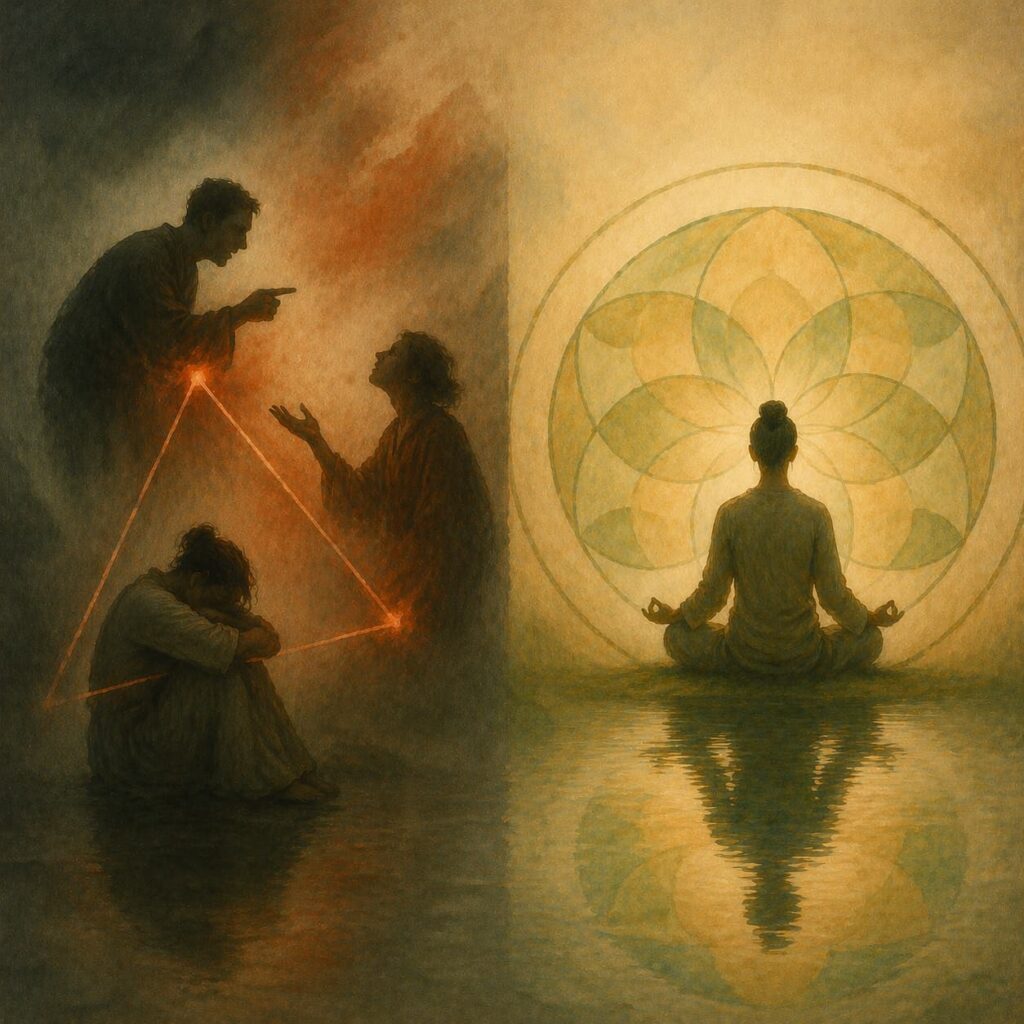
In ordinary clinical language, this means building space for:
- feeling
- thought
- boundary
- reflection
That is the beginning of moving from drama to consciousness.
A depth-oriented conclusion
The Drama Triangle endures because it is more than a model of conflict. It is a small mythology of human suffering.
It tells us who is innocent, who is guilty, and who will save whom. That is why it feels immediate, and why it can become addictive.
But myths and fairy tales do not only trap us. They also reveal us. Von Franz’s insistence that fairy tales are concentrated expressions of collective psychic processes, and Campbell’s linking of myth and dream, both help us see that these roles are not trivial social habits. They are symbolic positions in the psyche (Campbell, 1991; von Franz, 1996).
The work is not to deny that we enter them. We all do. The work is to recognise the pattern soon enough that we do not have to keep living inside it.
And that is where TA becomes genuinely liberating and becomes Depth TA.
Next Steps
Join TA101 or Book Open Evening to explore how Transactional Analysis helps us understand conflict, script, adaptation, and change.
Frequently Asked Questions
The Drama Triangle is a model in Transactional Analysis that describes three recurring relational roles: Victim, Rescuer, and Persecutor. It shows how conflict can become repetitive and emotionally charged when people move between these positions rather than relating directly and consciously (Karpman, 1968).
The Drama Triangle was developed by Stephen B. Karpman in 1968 as part of script and game analysis within Transactional Analysis (Karpman, 1968).
The three roles are Victim, Rescuer, and Persecutor. The Victim feels powerless or oppressed, the Rescuer feels compelled to help or save, and the Persecutor attacks, blames, criticises, or controls (Karpman, 1968).
It is called a drama triangle because the roles are not fixed. People switch between them, creating emotional reversals, conflict, and repetitive interpersonal scenes. The triangle captures the unstable and theatrical quality of these patterns (Karpman, 1968).
No. In the Drama Triangle, Victim refers to a psychological role within a recurring dynamic, not a denial that someone may have experienced real harm. A person can have been genuinely hurt and still become organised around a Victim position in ways that limit agency and reinforce repetition.
The Drama Triangle is often used to understand the roles people take up in psychological games. In TA, games are repetitive patterns of communication with hidden motives and predictable emotional outcomes. The triangle helps make those shifting positions visible (Berne, 1964; Karpman, 1968).
A Rescuer may become a Persecutor when their help is rejected. A Victim may become a Persecutor when resentment bursts out. A Persecutor may become a Victim when confronted. These switches are part of what gives the triangle its repetitive force (Karpman, 1968).
Helping respects the other person’s autonomy, limits, and capacity. Rescuing takes over, often without being asked, and may serve the rescuer’s need to feel needed, good, or in control. In that sense, rescuing is usually less relational than it appears.
Stepping out begins with recognising the role you are in and slowing the dynamic enough to make a different choice. The Victim moves toward agency, the Rescuer toward boundaried care, and the Persecutor toward directness without domination. In TA language, this often means moving into a more reflective Adult position.
What replaces it is not another role, but a different quality of relationship: more reflection, more responsibility, clearer boundaries, and greater tolerance for complexity. From a depth perspective, it means shifting from enactment to consciousness, and from role to relationship.
The Drama Triangle is important because it helps therapists and clients recognise repetitive relational patterns that can otherwise feel inevitable. It is clinically useful in work with couples, families, organisations, and therapy itself, especially where there is fast role-switching, blame, guilt, rescue impulses, or helplessness.
A depth perspective sees Rescuer, Persecutor, and Victim not only as social roles, but as symbolic and archetypal positions that appear in myths, fairy tales, and inner life. In this sense, the triangle is not just a communication pattern, but a dramatic structure through which the psyche enacts conflict, dependency, fear, and longing (Campbell, 1991; von Franz, 1996).
No. These positions are often adaptive responses shaped by early experience. They become problematic when they harden into repetition and replace genuine relationship. A depth-oriented TA perspective treats them as meaningful adaptations rather than simply as pathology.
Reference
Berne, E. (1966). Principles of group treatment. Grove Press.
Campbell, J. (1991). The power of myth (B. S. Flowers, Ed.). Anchor Books.
Jung, C. G. (1972). Mandala symbolism. Princeton University Press.
Karpman, S. B. (1968). Fairy tales and script drama analysis. Transactional Analysis Bulletin, 7(26), 39–43.
von Franz, M.-L. (1996). The interpretation of fairy tales (Rev. ed.). Shambhala.